
Senate Flips and Voter Turnout
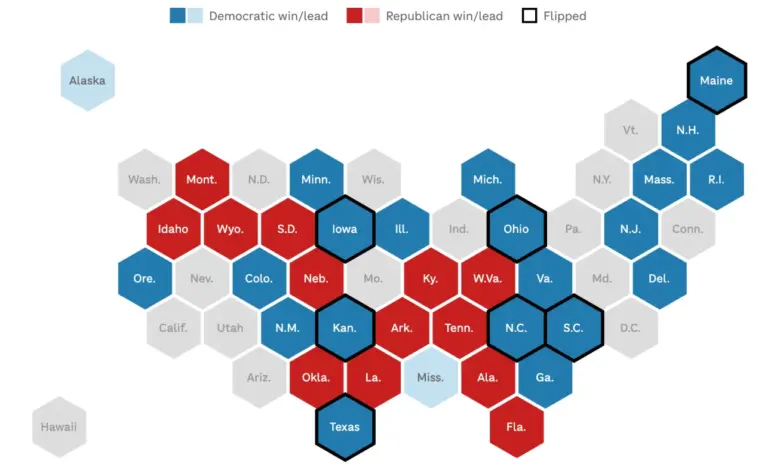
The most consequential outcome of the midterms is the Democratic capture of U.S. Senate seats in North Carolina, South Carolina, and Texas. In South Carolina, Democrat Annie Andrews flipped the seat, a result attributed in part to record voting participation in a gubernatorial election year. In North Carolina, former Governor Roy Cooper’s 20-point victory in the governor’s race likely helped propel Democratic gains in multiple congressional districts. In Texas, a state President Donald Trump won by more than 15 points in 2024, Democrats achieved a “romp” in statewide races, winning a majority of seats in the state House.
These results stand in stark contrast to the expectations following a Supreme Court ruling earlier this year that weakened provisions of the Voting Rights Act. In the aftermath of that decision, Republican-led states in the South rushed to redraw House districts. The goal was to create additional seats with larger Republican majorities to withstand the typical midterm penalty for the party in power. However, these efforts largely backfired. In Alabama, a redistricting plan intended to unseat Representative Shomari Figures failed; he won by nearly eight points in the new configuration. In Tennessee, where Memphis was split into three districts, Democratic state Representative Justin Pearson remains within a few thousand votes of winning, highlighting the resilience of Democratic turnout despite structural challenges.
Black voter turnout was a central driver of these shifts. Ashley Kennedy Shelton, of the Louisiana-based Power Coalition for Equity and Justice, noted that the Supreme Court ruling made the stakes feel “personal” for Black voters, who are also dealing with rising costs for electricity, gas, and food. In Louisiana, Democrat Jamie Davis narrowly lost to Senator-elect Julia Letlow by less than two percent, a margin that underscores the increased competitiveness of the state. Mississippi’s Senate race remains too close to call, with Democrat Scott Colom leading incumbent Republican Cindy Hyde-Smith by fewer than 1,200 votes in a state with the highest share of Black voters in the country.
State-Level Power Shifts
The impact of the midterms extends well beyond Congress, reshaping state governments across the region. In Georgia, Democratic Senator Jon Ossoff’s 18-point victory helped propel former Atlanta Mayor Keisha Lance Bottoms to the governor’s seat. Bottoms will become the first Black woman governor in the nation. Democrats swept every statewide elected office in Georgia, gained control of the state utility regulator, and are set to win a majority in the state House.
Similar down-ballot gains occurred in other states. In North Carolina, Cooper’s victory is expected to flip multiple congressional seats and secure Democratic control of the state House. In Florida and South Carolina, the Republican House supermajorities have ended, although Republicans held on to the Florida governor’s seat and U.S. Senate seat. Even in less purple states such as Alabama, Arkansas, Kentucky, and Tennessee, dozens of local and state pickups were reported for Democrats.
Implications for 2028
The expansive majorities built upon these southern swings have implications for the next presidential cycle. Both parties are already positioning themselves for the 2028 race, with potential contenders investing heavily in the region. On the Democratic side, former Transportation Secretary Pete Buttigieg, Georgia Senator Raphael Warnock, and Kentucky Governor Andy Beshear, who chairs the Democratic Governors Association, made notable appearances to support nominees in tight races. On the Republican side, Texas Senator Ted Cruz and Vice President JD Vance focused their efforts on the region.
Together, Texas, Florida, Georgia, and North Carolina represent more than one-third of the 270 electoral votes required to win the White House. The closer-than-expected margins in these states, particularly in Florida and Texas, make them attractive investments for both parties seeking an edge with voters. The 2026 results suggest that the South is no longer a monolithic Republican stronghold but a highly contested region where incremental gains in voter turnout and state-level power can determine national control.
The next critical step will be the certification of results in Mississippi and the final confirmation of House seats in the redistricted districts of Alabama and Tennessee. As the new Congress convenes, the balance of power in the Senate and the composition of the House will define the legislative agenda and set the stage for the 2028 campaign.