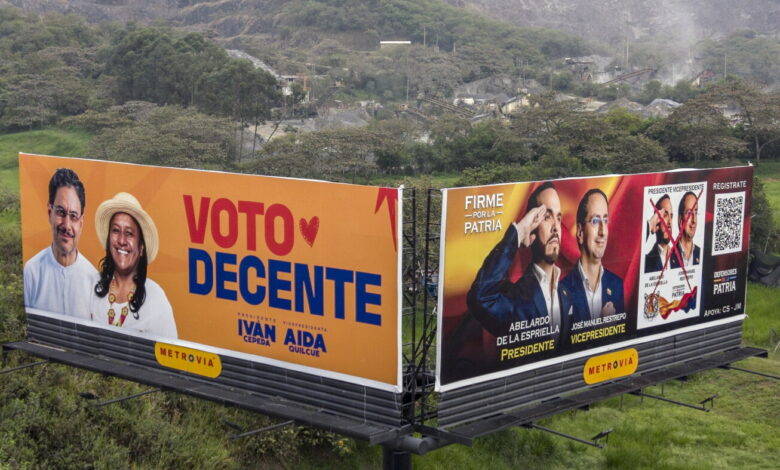
The race pits two candidates with fundamentally different visions for Colombia’s security policy against a backdrop of persistent violence. Abelardo De La Espriella, a far-right criminal defense attorney and political newcomer, leads in polling following the May 31 first-round election, where he finished first among thirteen candidates. His platform centers on a hardline approach to the country’s remaining armed groups. De La Espriella, who has received an endorsement from U.S. President Donald Trump, has pledged to launch a military offensive against guerrillas immediately after taking office. “I will give the order to bomb all of the camps holding narco-terrorists,” he stated in a recent Colombian television interview. He further specified that the military would shoot down aircraft and sink boats involved in cocaine smuggling.
His opponent, Iván Cepeda, a left-wing senator and protégé of outgoing President Gustavo Petro, offers a contrasting strategy rooted in negotiation. Cepeda, who finished second in the first round, argues that diplomacy remains the only viable path forward. “Even in the worst of times, Colombia has chosen life, democracy, hope and peace as the path forward,” Cepeda said at a campaign rally. His candidacy represents the continuation of the “Total Peace” plan, an initiative launched by the Petro administration that involves simultaneous talks with nearly a dozen rebel factions.
The political significance of this runoff extends beyond the immediate rivalry between De La Espriella and Cepeda; it reflects a broader rightward shift observed in parts of Latin America. However, the efficacy of the current peace process is a central point of contention. While the “Total Peace” plan has engaged multiple groups, most negotiations have ended in frustration. The demobilization of the Border Commandos stands out as the sole tangible success. Despite the ceremony, the impact remains limited. Of the group’s estimated 1,000 fighters, only 100 members turned in their weapons. Antonio Paguey, a social worker from La Ruidoso, a village under the group’s control, noted the practical difficulties of partial disarmament: “If some turn in their guns and others don’t, it doesn’t make much sense.”
Understanding the current security landscape requires looking at the historical context of Colombia’s conflict. The rebel groups currently active are largely offshoots of the Revolutionary Armed Forces of Colombia (FARC). The FARC, which fought to overthrow the government from the 1960s until its 2016 peace treaty, was the country’s largest guerrilla organization. Following the treaty, nearly all 15,000 FARC combatants were demobilized. However, a faction remained in the jungle, recruiting new fighters to form the next generation of rebel organizations. Unlike the FARC, which had ideological aims, these successor groups are primarily engaged in illicit economies, including cocaine smuggling, extortion, illegal gold mining, and logging.
The divergence in strategy between the candidates highlights a critical uncertainty in Colombian governance. De La Espriella’s proposed military offensive aims to dismantle these criminal networks through force, a method that carries risks of escalating violence and civilian casualties. Cepeda’s approach relies on the premise that engagement, even when fraught with difficulty, is superior to confrontation. The failure of most “Total Peace” talks to yield results has weakened the argument for the status quo, yet the alternative of total military suppression remains untested at this scale.
As the runoff concludes, the outcome will reshape Colombia’s relationship with its armed groups and its international partners. If De La Espriella wins, the country may see a rapid escalation of military operations, potentially reversing the cautious, albeit partial, progress seen in the south. If Cepeda prevails, the government will continue to pursue negotiations with groups that have shown limited willingness to disarm fully. In either scenario, the question of whether Colombia’s recent attempts at peace were a viable strategy or a costly delay remains unresolved, leaving the nation’s security future in a state of flux.