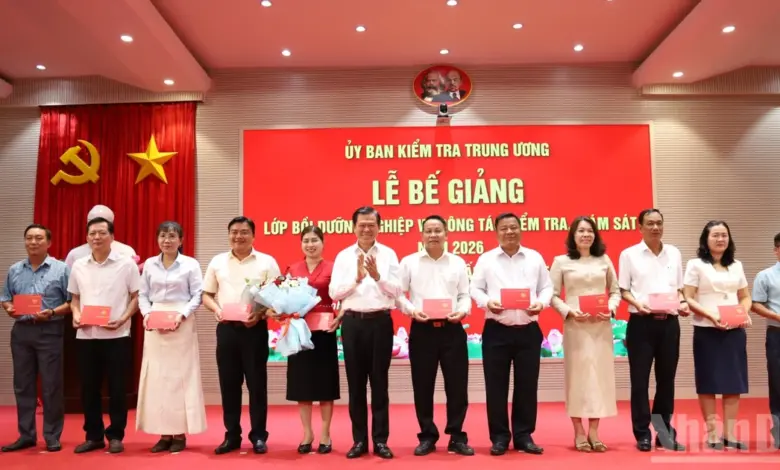
Delivering the keynote address, Nguyen Hong Linh, Member of the Central Committee and Vice Chairman of the Central Inspection Commission, stated that 2026 represents a “fundamental and substantive change” in cadre training. According to Linh, the Commission conducted a comprehensive survey to define training targets based on the hierarchical structure of inspection cadres, specifically distinguishing between provincial and commune-level responsibilities. This stratified approach reflects the Party’s recognition that the challenges facing oversight bodies have evolved. The current inspection sector employs more than 20,300 officials and civil servants in specialized roles. Of this workforce, approximately 18,000 are stationed at the commune level. Linh described these grassroots staff as the “frontline force,” directly responsible for protecting the Party’s disciplinary foundation in the areas closest to the public and Party members.
The political significance of this restructuring is rooted in the directives of the Fourth Plenary Session of the 14th Central Committee. This session reaffirmed the role of inspection and supervision as a core component of Party building and rectification. The policy framework now explicitly calls for innovation not only in thinking and methods but also in the implementation of power control mechanisms. The central objective is to enhance the ability to prevent and provide early warnings, thereby strictly controlling power and building a team of officials characterized by courage, honesty, and professional competence. For the newly appointed members of Inspection Committees, the primary challenge identified by leadership is not merely a lack of procedural knowledge, but a necessary transformation in mindset and working methods to adapt to this new governance model.
This institutional reform is part of a broader, multi-year strategy to modernize Party discipline, a concept with deep historical roots in Vietnamese political thought. The sources cite President Ho Chi Minh’s longstanding view that inspection is one of three decisive factors in the success of Party policies, alongside organization and cadre selection. His assertion that “nine-tenths of the shortcomings in our work are due to a lack of inspection” has remained a guiding principle. The 14th Party Congress continued this tradition, emphasizing that inspection is the “main and very important leadership method to maintain Party discipline and order.” The current initiative seeks to operationalize this historical mandate through contemporary tools, specifically identifying digital transformation and data application as key breakthroughs for improving the effectiveness and efficiency of supervision.

The scope of this overhaul extends beyond the civilian administrative apparatus to the military sector. On June 2, 2026, the Central Military Commission issued Resolution No. 624-NQ/QUTW, which mandates the innovation of inspection work within the Party Committee of the Army for the 2025–2030 term. This resolution aligns with the wider Party strategy, emphasizing a shift in focus toward preventing and warning against violations. It requires regular supervision at the grassroots level and prompt inspections of Party organizations and members—particularly those in key positions—when signs of violation emerge. The military’s adoption of these new methods mirrors the civilian sector’s push for a more proactive, rather than purely reactive, disciplinary stance.
The training course that concluded in Ho Chi Minh City was designed to translate these high-level policies into practical skills. The curriculum, completed with 100% of planned content, focused on equipping trainees to “advis[e] the Standing Committee and the Party Committee” effectively. Key competencies included the flexible application of new methods, the strengthening of supervision in the digital environment, and the cultivation of public service ethics. Trainees were instructed to identify violations early and conduct inspections that are “accurate, focused, and targeted.” All 189 participants, who are specialists in the Inspection Commissions of grassroots Party Committees, were deemed eligible for Certificates of Completion upon the course’s conclusion.
The implementation of these new standards raises questions about the practical challenges of digital oversight in a decentralized political structure. While the Party has outlined clear directives for “strictly controlling power” and “preventing violations,” the success of these measures depends on the capacity of local cadres to navigate complex digital environments and maintain integrity. The emphasis on “courage” in the new cadre profile suggests that leadership anticipates potential resistance or difficulty in enforcing these stricter standards at the local level. As the inspection sector integrates data-driven tools into its workflow, the next phase of this political development will likely involve the monitoring of compliance with the new digital supervision protocols and the evaluation of how effectively these methods reduce disciplinary breaches at the commune and military unit levels.