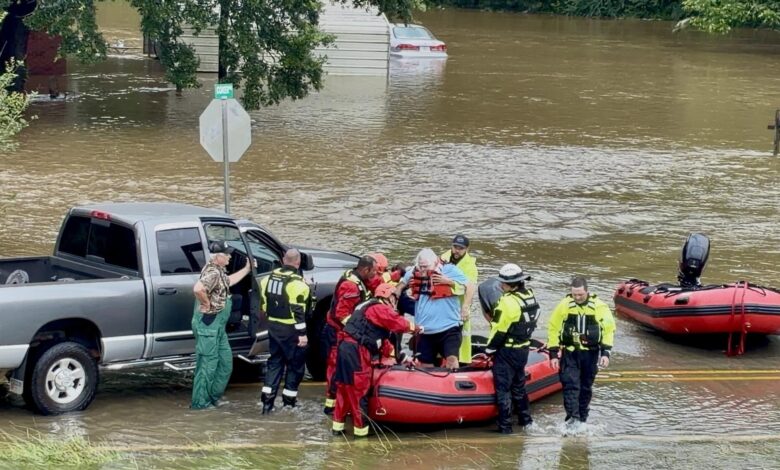
The storm has presented significant challenges for emergency responders due to immense rainfall and already elevated water levels. Reeves described the event as a “bear to deal with,” noting the complexity of managing diverse flood-related damages. A specific concern involving a potential dam break in Pearl River County was addressed by the Mississippi Department of Environmental Quality; officials stated that the Anchor Lake dam is currently in safe operating condition and under close monitoring. In Harrison County, the Biloxi River reached a record crest of 31.82 feet, prompting more than 96 high-water rescues and the closure of over 97 roads. Stone County completed 59 rescue and relocation missions, while George County reported a washed-out section of Highway 26 West.
Shelters are open for residents in need across multiple counties, including American Red Cross facilities in Hancock, Harrison, and Stone counties, as well as a safe room in Picayune, Pearl River County. Reeves praised local emergency managers, police, and fire departments for their response, emphasizing that flood recovery requires a flexible and specialized strategy. While some water levels in Pearl River County are receding, Jackson County is preparing for continued flooding as the Pascagoula and Escatawpa rivers rise toward flood stage.

Amidst these regional challenges, a broader coalition of river communities is moving to improve disaster infrastructure. The Mississippi River Cities and Towns Initiative (MRCTI), a cooperative of more than 100 communities from Minnesota to Louisiana, launched a new disaster relief effort during its annual meeting in the Twin Cities. The initiative, formed in the wake of the 20th anniversary of Hurricane Katrina and recent severe storms, aims to deliver aid within 72 hours of a disaster event. This rapid response program, a partnership with the non-profit Convoy of Hope, is designed to provide food, water, and hygiene supplies during the critical first 36 to 72 hours when local budgets are often depleted.
The coalition is also lobbying lawmakers to reform the Federal Emergency Management Agency (FEMA). MRCTI officials cited an Associated Press analysis indicating that major disaster declarations are taking longer under the current administration than historical averages. Missouri Mayor Stacey Kinder noted that her state has suffered over $2 billion in losses since March, including from an EF-3 tornado in Selmer, Tennessee, which damaged 332 structures and killed five people. While MRCTI did not disclose the financing for the new 72-hour aid program, it is available immediately to partnering cities. The initiative seeks to build resilience by positioning resources before disasters strike, reducing reliance on delayed federal responses.