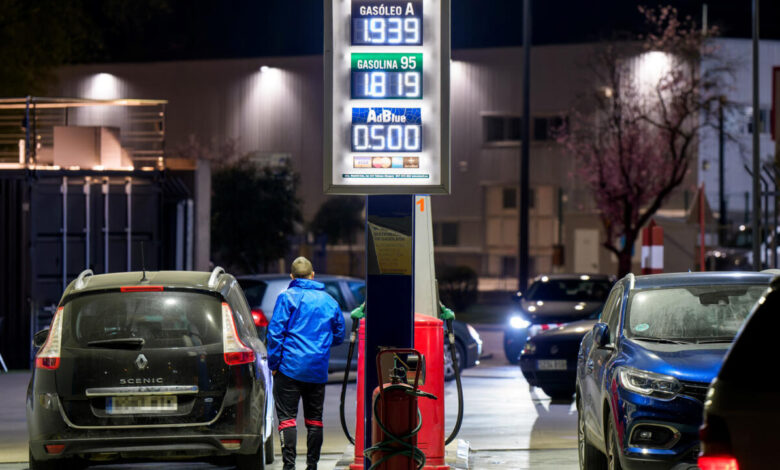
Under the new measures, a discount of 20 euro cents per litre for petrol and diesel will apply in October, progressively decreasing to 13 cents in November and six cents in December. A “reactivation clause” allows for increased support if prices spike by more than 15 percent. Ecological Transition Minister Sara Aagesen confirmed that gas price spikes are capped at 15 percent, noting that without these limits, household gas prices would rise by more than 45 percent starting next month. The price of butane tanks, widely used for cooking and heating, will also be capped at 19.55 euros.
Spain has secured European Union permission to cut fuel taxes below the bloc’s normal minimum levels, a flexibility granted due to the exceptional geopolitical situation. An official European Commission document dated 25 August confirmed that the European Council recognized the need for “targeted solutions” to ensure affordable energy availability. Spain requested this derogation in a letter dated 28 June, citing the closure of the Strait of Hormuz and the resulting oil-price shock. The Commission deemed the measure adequate and proportionate, noting that inaction would lead to higher fuel prices feeding into household and business costs. In July, the tax cut was equivalent to approximately 15 cents per litre compared to pre-conflict rates.
The government’s intervention supports a broader strategy that has already insulated the Spanish economy from some energy volatility. Since the Iberian blackout of April 2025, Spain has reinforced its push for renewable energy, which is now shielding consumers from elevated gas prices. In 2021, gas influenced power prices in an estimated 52% of hours in Spain; by the first five months of 2026, this influence had dropped to just 9% due to a 37% increase in wind and solar generation between 2021 and 2025. Consequently, while European gas prices climbed by around 75% following the outbreak of the war, Spanish electricity prices have remained largely unaffected, with Spain and Portugal ranking among the EU’s three cheapest power markets in each of the first four months of 2026.
The previous support package, approved in March at a cost of 5 billion euros, reportedly helped 20 million households and three million businesses. The current measures aim to maintain this protection as the conflict continues to drive energy market volatility. With uncertainty persisting regarding free navigation through the Strait of Hormuz, the Spanish government emphasizes that these are essential measures to protect against a vulnerable economic situation.
The next significant operational milestone involves the monthly adjustment of fuel discounts, with the first reduction scheduled for November. Regulators will monitor market prices to determine if the reactivation clause is triggered.