
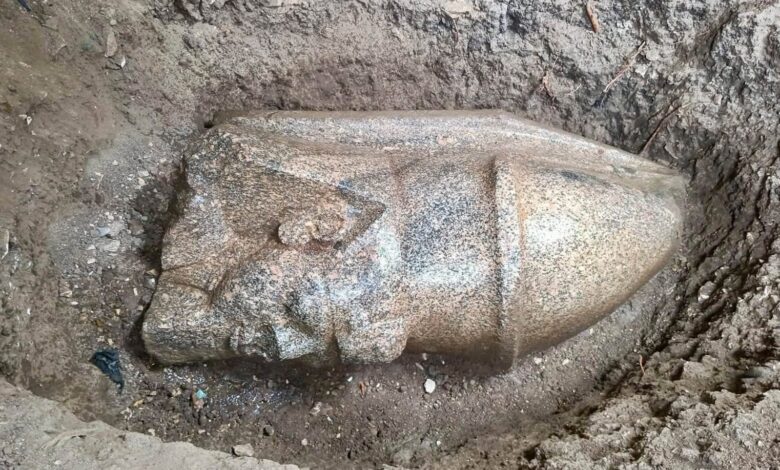
The investigation began when a local resident discovered an inscribed stone block while working on land adjacent to his home. Upon reporting the find to the local antiquities inspectorate, the SCA dispatched a specialized committee and excavation team to conduct rescue operations. The team recovered a statue head measuring approximately 1.60 meters in height, depicted wearing the pschent, the double crown symbolizing the unification of Upper and Lower Egypt. A fragment of the statue’s back pillar bears an inscription identifying the king’s Horus name as “Hor-ka-nakht-mery-maat.” Based on the dimensions of the surviving head, researchers estimate the complete statue, including its base, originally stood approximately 8.5 meters tall.
The second discovery is a substantial portion of another royal statue, measuring roughly 2.40 meters in height. While the legs and base are missing, the figure retains a clearly preserved face and wears the nemes, the striped royal headdress. Although the upper section of the headdress is damaged, the facial characteristics closely resemble those of the first statue, leading experts to preliminarily identify this fragment as another representation of Ramses II. This identification is supported by a pink granite block found approximately one meter north of the second statue. The block, measuring about 1.30 meters in length, features hieroglyphic inscriptions containing two royal titles: “Nesu Beti,” meaning King of Upper and Lower Egypt, and “Sa Ra,” meaning Son of Ra.
The site of Behbeit El-Hagar is a significant archaeological location in the Nile Delta, previously known for the ruins of a large temple dedicated to the goddess Isis and scattered architectural granite blocks. Dr. Hisham El-Leithy, Secretary-General of the SCA, stated that excavations and studies will continue to locate additional fragments and determine how the objects relate to the broader site. Minister of Tourism and Antiquities Sherif Fathy acknowledged the villager’s role in protecting the nation’s heritage, highlighting the importance of citizen reporting in archaeological preservation.
The identification of the second statue remains preliminary, resting on visual similarities in facial features and the proximity of the inscribed granite block rather than direct epigraphic confirmation on the statue itself. The discovery underscores the scale of Ramses II’s architectural projects, which spanned Egypt and Nubia. Further investigation is required to fully understand the context of these monuments and their relationship to the ancient settlement.