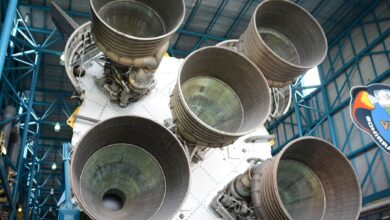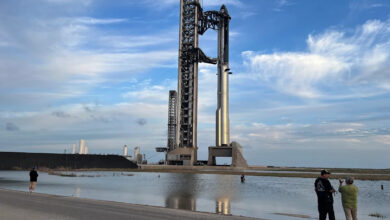
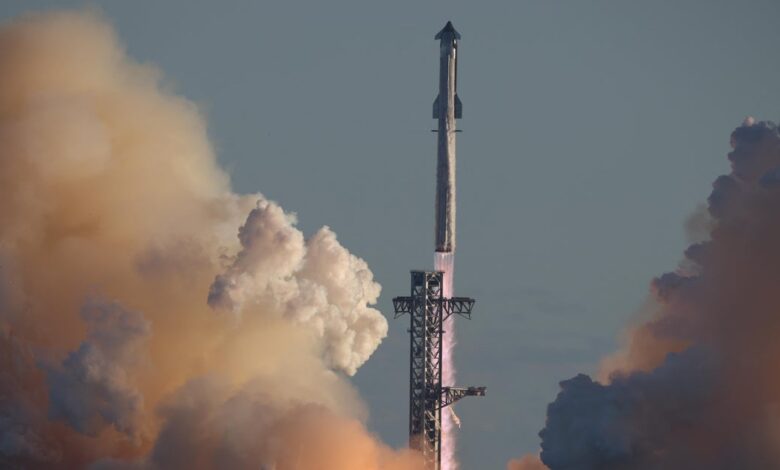
The mission, lasting approximately 22 hours, was designed to test the full reusability cycle of the Super Heavy booster and the Starship upper stage. The vehicle, standing 236 feet tall for the booster and 171 feet for the upper stage, lifted off from Starbase at 5:47 p.m. ET, fueled by 8 million pounds of supercold liquid oxygen and methane. The first stage, powered by 33 methane-burning Raptor engines, separated from the Starship roughly two minutes and 20 seconds after liftoff, after propelling the vehicle out of the lower atmosphere.
However, the mission did not proceed entirely as planned. While the Starship continued its ascent, the Super Heavy booster attempted a return-to-launch-site maneuver, firing its engines to reverse course. Approximately six minutes after liftoff, flight controllers ordered a diversion to a splashdown in the Gulf of Mexico due to an unspecified technical problem. Long-range cameras captured the booster descending into the Gulf, where residual propellants ignited, creating a fireball moments before impact. The specific cause of the failure and the subsequent explosion remains under investigation, though SpaceX noted that flight plans always include a splashdown option if conditions preclude a safe capture. This outcome contrasts with three previous test flights in which the Super Heavy booster was successfully caught by the gantry arms.
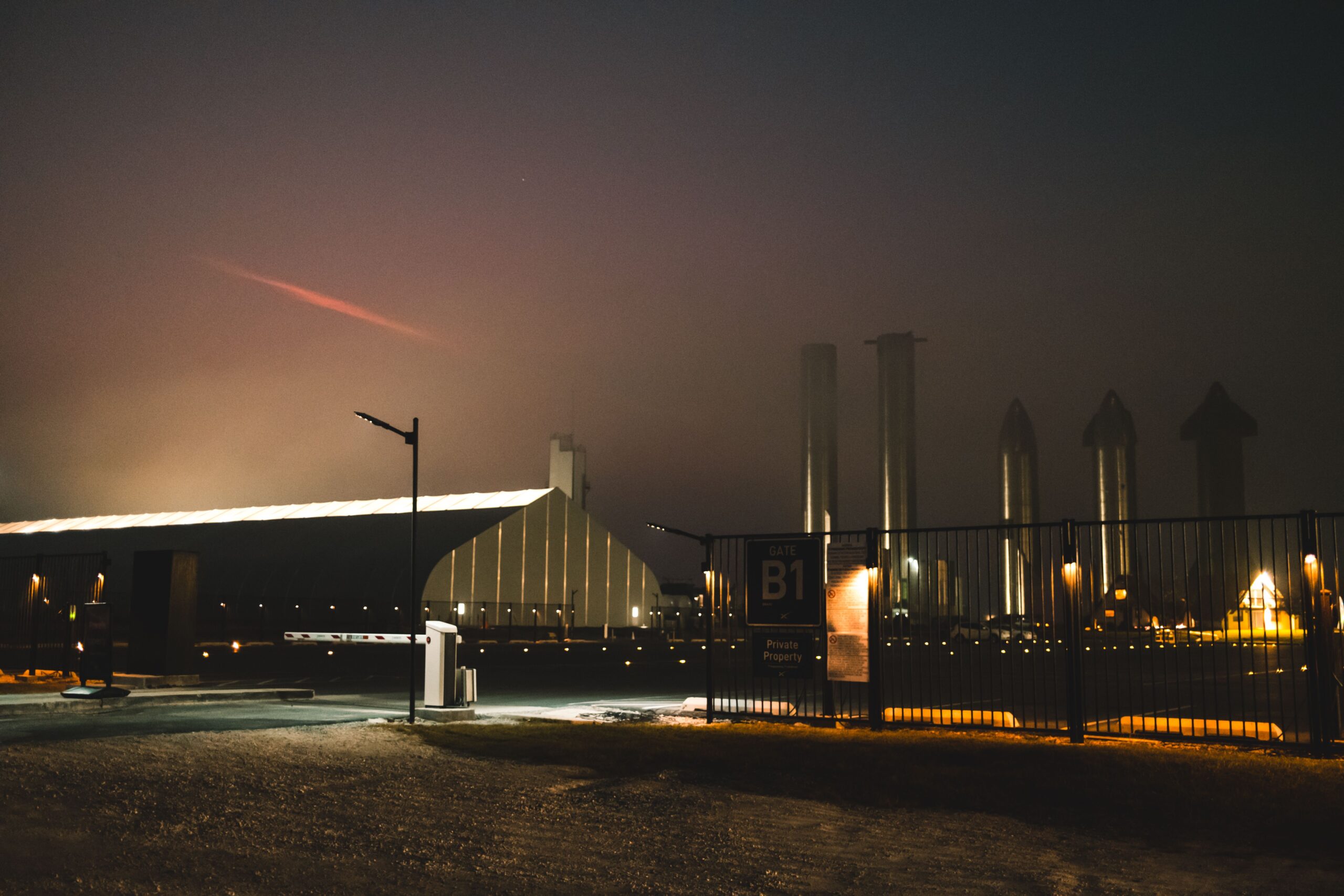
In contrast, the Starship upper stage executed its planned trajectory with precision. Following separation, the Starship performed a suborbital coast phase for 18 minutes, allowing flight controllers to assess the vehicle’s health. With no issues detected, a single Raptor engine reignited for a 10-second burn, injecting the craft into its planned orbit. Approximately 8.5 minutes later, the vehicle deployed its first payload: one of 26 upgraded version 3 Starlink internet satellites. The remaining satellites were not deployed, as the primary objective of this flight was the recovery of the vehicle itself.
The remainder of the mission focused on monitoring the Starship’s condition during reentry. SpaceX’s flight control teams maintained multiple abort options, including pre-cleared splashdown zones in the Pacific Ocean near Hawaii and off the coast of Chile, in case the vehicle’s health deteriorated. Ultimately, the Starship completed its de-orbit burn and reentered the atmosphere, descending toward Starbase. In a dramatic conclusion to the 22-hour mission, the vehicle was snagged by the launch pad’s mechanical arms, marking the first successful land-based capture of an orbital rocket stage.
The significance of this achievement lies in the validation of the engineering systems required for rapid turnarounds. By recovering the upper stage, SpaceX can now test refurbishment processes that aim to reduce the cost of orbital access. The Super Heavy booster’s failure to be caught, however, highlights that the full reusability loop remains unproven. The booster’s crash in the Gulf indicates that technical challenges persist in the precise control and recovery of the first stage, even after previous successes. The explosion observed before splashdown suggests potential issues with propellant management or structural integrity during the divergent trajectory.
SpaceX has stated its intention to continue testing, with future flights likely to focus on resolving the issues that prevented the booster’s capture while refining the procedures for the upper stage’s recovery. The successful capture of the Starship stage provides a physical asset for detailed post-flight analysis, offering insights into heat shield performance and engine behavior after orbital flight. While the booster’s failure is a setback for the complete reusable system, the upper stage’s safe return represents a substantial step forward in the industry’s long-term goal of making spaceflight more accessible and economically viable.
The next steps for the program will involve a thorough review of the booster’s telemetry to identify the root cause of the failure. Meanwhile, the recovered Starship stage will undergo inspection and refurbishment, providing data essential for the next test flight. The success of the upper stage’s capture demonstrates that the technology for orbital recovery is functional, but the integration of a fully reusable two-stage system remains an ongoing engineering challenge.