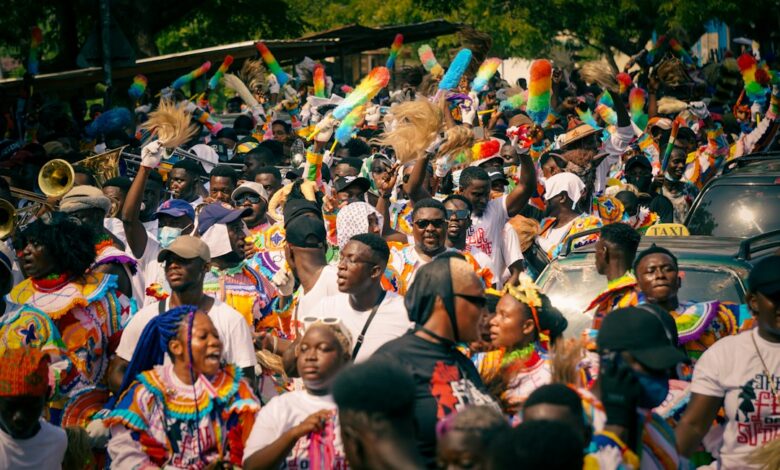
Bediako’s entry into politics was as unorthodox as his personal branding. Until early January, he was known primarily as a businessman and philanthropist. His campaign began not with a traditional rally, but with a mystery: billboards featuring a masked figure appeared across major cities, leaving the public to speculate about the candidate’s identity. The unveiling was intended to be a grand convention at Black Star Square in Accra, featuring high-profile populist figures such as Nigeria’s Peter Obi and South Africa’s Julius Malema. However, military personnel intervened shortly before the event was to begin. A letter from the president’s office, dated January 7, stated that the permit for the venue had been revoked due to an “unforeseen state event.” The cancellation did not stop the momentum; within 24 hours, new billboards bearing Bediako’s name and the hashtag #thenewforce had been posted nationwide.
The central development in this political cycle is the emergence of a serious third-force challenge in a country where the National Democratic Congress (NDC) and the New Patriotic Party (NPP) have dominated power since the return of multiparty politics in 1992. Bediako, running as an independent candidate backed by his New Force Movement, is targeting the 55 percent of registered voters aged between 18 and 35. His appeal lies in a blend of pan-Africanism, echoing the legacy of Ghana’s first leader, Kwame Nkrumah, and a digital-first strategy that resonates with a generation facing economic hardship.
The political significance of Bediako’s run extends beyond his personal ambition. In an interview, he redefined success, stating, “I’ve awakened their spirit… Becoming president is one thing, but I will respect the fact that I’ve been able to unify the mindsets of the people, I call that winning.” George Bob-Milliar, a professor of African studies at Kwame Nkrumah University of Science and Technology, noted that Bediako has entered “a very free space that allows for popular expressions of people’s aspirations.” Bob-Milliar suggested that if Bediako can deny the two major parties a first-round victory, he positions himself to negotiate significant political concessions, effectively changing the bargaining dynamics of Ghanaian democracy.
However, the institutional reality of Ghanaian politics poses a steep barrier. The country has a reputation for orderly, peaceful transfers of power between the NDC and NPP over the past three decades. The current election pits Vice President Mahamudu Bawumia (NPP) against former President John Mahama (NDC), with incumbent President Nana Akufo-Addo concluding his second and final term. Political analysts describe Bediako’s prospects as an uphill battle, noting that while there is an appetite for change, the structural dominance of the two major parties remains formidable. Bediako’s campaign, which includes flamboyant imagery—army-commander-styled outfits, gold embellishments, and poses with lions and luxury cars—has drawn criticism for being overly theatrical, yet it has successfully captured the imagination of a youth demographic that feels politically voiceless.
The backdrop for this contest is a severe economic crisis that has fueled public discontent. At the end of 2022, annual inflation hit 54%, and the World Bank estimated that 850,000 Ghanaians were pushed into poverty that year, joining the six million already living in poverty. The government’s finances were depleted, forcing a bailout from the International Monetary Fund. Unemployment among the young and a significant exodus of skilled workers have become defining features of the recent years. The NDC labels the incumbent’s performance “abysmal” and demands a reset, while the NPP argues it has built a resilient economy on the “cusp of transformation.”
Bediako’s policy platform centers on economic sovereignty. He argues that Ghana cannot develop with significant industrial control in foreign hands, citing profit repatriation from foreign-owned businesses in banking and mining as a drain on the local economy. “We are suffering from too much foreign influence in our economy,” he said. His proposed solution is a shift toward industrialization and manufacturing to create jobs and wealth, a stance that aligns with populist sentiments seen in other African nations where youth-led movements have rocked the establishment.
Controversy has also surrounded the campaign’s methodology. In a recent appearance at a committee room in the Palace of Westminster in London, Bediako claimed to be representing “Africa’s greatest hope.” Subsequent social media posts suggested the trip involved a presentation in Parliament itself, a claim that appears to be a loose framing of the event, highlighting the tension between Bediako’s promotional narrative and verified facts. Despite these inconsistencies, his ability to mobilize through technology and social media remains his most potent asset.
As the election date of 7 December approaches, the uncertainty lies not in who will win the presidency, but in whether Bediako’s movement will leave a lasting structural impact on Ghanaian politics. The major parties are forced to engage with the youth electorate more directly, acknowledging that the old binary of NDC versus NPP is no longer the sole lens through which voters view their options. Whether this results in a negotiated third-party seat at the table or a temporary surge of enthusiasm that fades with the vote count remains to be seen. For now, the “Prince of Africa” has successfully disrupted the silence of the status quo, forcing the established institutions to confront the aspirations of a new generation.