
Tobias Rausch, the AfD candidate, was elected parliamentary speaker following the party’s victory in the September 6 regional election. While Rausch received the expected support from his own party and the Alliance for Social Justice and Economic Rationality (BSW), secret ballot records indicate he also secured four additional votes. Most observers believe these extra votes could only have originated from right-wing CDU lawmakers, despite the explicit insistence of CDU Chairman and Chancellor Friedrich Merz that his party would not cooperate with the AfD in any capacity.
“Electing far-right extremists to such an office represents a taboo brake. Not only the BSW, but also the CDU must urgently explain how this could have happened,” said Lars Klingbeil, Vice Chancellor and Finance Minister.
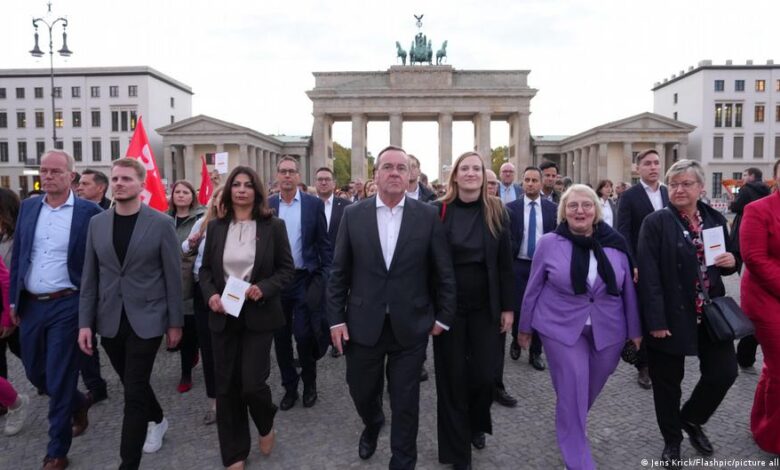
The events in Magdeburg have cast a significant shadow over the federal governing coalition, of which the Social Democratic Party (SPD) is the junior partner. Leading SPD members responded swiftly to the parliamentary vote, organizing a protest march in Berlin on Tuesday. The demonstration began at the Bundestag and proceeded to Bebelplatz, a site historically significant for the Nazi book burnings of 1933. The march concluded with Boris Pistorius, the SPD Federal Minister of Defense, leading the crowd in the German national anthem. Many participants displayed copies of the German Basic Law, emphasizing their commitment to the rule of law and constitutional democracy.
Thorsten Frei, leader of the CDU parliamentary group, addressed the controversy with cautious wording, noting that the nature of the vote complicates attribution. “It’s a secret ballot, so of course, in principle, anybody is suspect,” Frei stated. He added that the occurrence of such a result is “extremely troubling and cause for concern.” The ambiguity surrounding the source of the additional votes has intensified political debate regarding the implementation of the so-called “firewall” policy, which traditionally prevents democratic parties from cooperating with the AfD.
The AfD’s victory in Saxony-Anhalt highlights the shifting political landscape in the region. The party captured 44 percent of the vote, campaigning on platforms that included extremely tough immigration policies, climate change denial, and the near-total abolition of public broadcasting. Despite this electoral success, the AfD does not possess a parliamentary majority in the state. Furthermore, the regional branch of the party has been classified as “confirmed right-wing extremist” by the Office for the Protection of the Constitution. Analysts note that while the “firewall” approach has struggled to maintain effectiveness at municipal and city levels, cooperation with the AfD remains viewed by many as a dangerous slippery slope for democratic institutions.