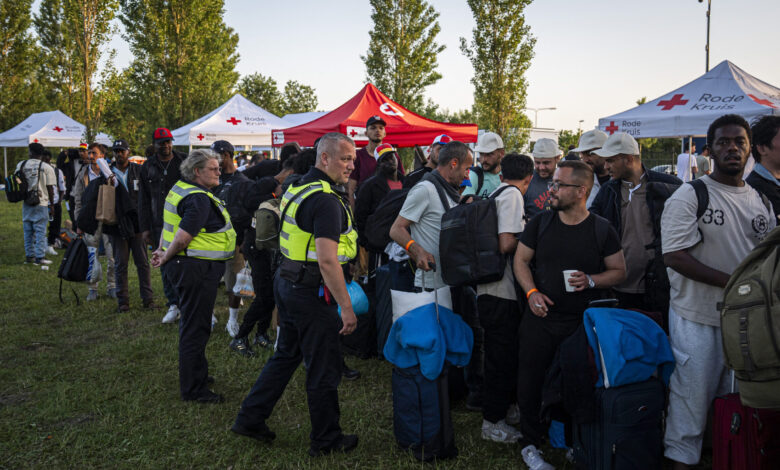
The decision to withdraw was precipitated by a pattern of violent incidents, most notably two stabbings inside the centre last week. A third stabbing, committed by an asylum seeker from Ter Apel in central Amsterdam, further underscored the security concerns cited by aid workers. Harm Goossens, director of the Red Cross, stated that the safety of employees could no longer be guaranteed. The organizations reported that their work, which included distributing meals, water, and blankets, providing shelter, and identifying vulnerable arrivals, had become impossible amidst intimidation, fights, and fears of theft involving money and mobile phones.
Aid workers noted that the violence was largely perpetrated by a relatively small group of male asylum seekers with little prospect of receiving asylum. Some of these individuals had previously stayed inside the centre, while others appeared to come from outside. Following the withdrawal, the vacuum in security and support was immediate. On the night of 11 July, a small group of men repeatedly confronted one another and other asylum seekers. Security staff took one man inside the compound after a fight, coinciding with the arrival of four police vehicles and an ambulance. In another incident, police broke up a confrontation without making arrests, while beer bottles were smashed during several disturbances, though no injuries were reported from those specific clashes.
The instability at Ter Apel is symptomatic of a broader structural failure within the Dutch asylum system. The centre has a maximum occupancy of 2,000, yet it was reported to hold 2,316 asylum seekers as of 20 May. In response to this overcrowding, the Central Agency for the Reception of Asylum Seekers restricted entry, prioritizing only ‘vulnerable’ applicants. Consequently, dozens of non-prioritized asylum seekers have spent their days outside the facility before being transported to temporary overnight sites; on the night of 10–11 July, 53 individuals slept in Nieuwe Pekela. This provisional arrangement reflects a wider issue: 19,000 recognized refugees remain in similar facilities across the country due to a severe lack of available housing.
The problems at Ter Apel are not entirely new. In 2022, hundreds of asylum seekers slept outside the centre in unhygienic conditions with inadequate access to medical care, prompting the global medical NGO Médecins Sans Frontières to intervene on site. However, the current situation has intensified, with security problems and disorder extending to many more migrant centres across the nation. The tension between state reception capacity and local community acceptance is increasingly visible in other parts of the country.
In Loosdrecht, for example, protests began in late April after authorities announced plans to accommodate 110 single male asylum seekers in a former town hall. Residents accused officials of inadequate consultation and disregarding local safety concerns. Although the proposed number was later reduced to 70, the situation remained volatile. On 12 May, as the first 15 residents arrived, hundreds of demonstrators gathered outside. Rioters threw fireworks and flares, ignited vegetation against the building, and clashed with riot police. The protests in Loosdrecht have continued for weeks, and the atmosphere remains tense.
As the Dutch government grapples with a housing shortage that affects both recognized refugees and new arrivals, the departure of humanitarian partners from Ter Apel represents a significant escalation. The immediate consequence is a reduced safety net for those in the queue for registration, while the longer-term implication is a deepening fracture in the social contract surrounding migration policy. With no immediate resolution to the housing crisis or the security vulnerabilities at reception centres, the standoff between the state, aid organizations, and the public shows no signs of abating in the near term.