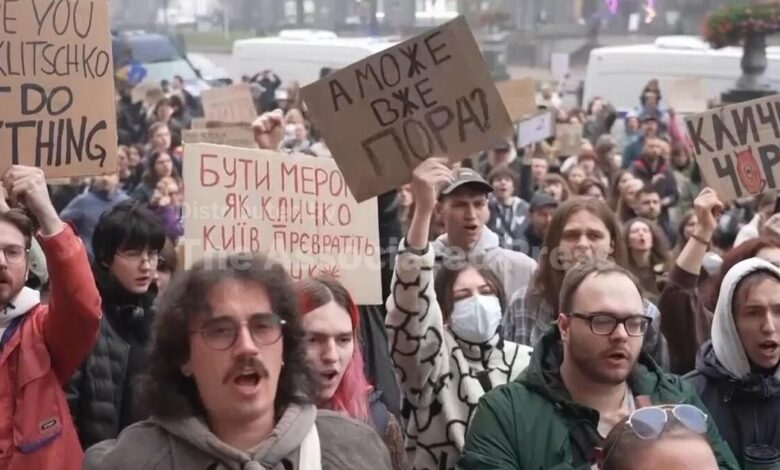
Demonstrators chanted “Kyiv without Klitschko” and held signs reading “Where are the shelters?” and “12 years of irresponsibility.” Many protesters mocked the mayor’s recent advice for residents to consider relocating ahead of the cold season, turning the suggestion back on him with placards urging him to “leave Kyiv.” Oleksii Hromov, an activist with the NGO Social Movement who co-organized the event, stated that Klitschko’s resignation would send a positive signal across Ukraine, demonstrating that city leaders must fulfill their duties.
The public outcry follows a sharp public dispute with President Volodymyr Zelenskyy, who has accused the Kyiv administration of failing to meet deadlines for reinforcing the city’s infrastructure. On October 13, President Zelenskyy stated that resilience plans had been implemented more effectively in “almost all regions of Ukraine, including border and front-line areas,” than in the capital. He specifically criticized the city’s readiness regarding critical infrastructure, a charge that has fueled resentment among both residents and opposition figures.
Klitschko, the former world heavyweight boxing champion who has served as mayor since 2014, has rejected these allegations. In a recent interview with the Associated Press, he described the president’s comments as “unfounded” and argued that “finding scapegoats won’t make people warmer.” The political friction between the two figures dates back to 2019, shortly after Zelenskyy assumed the presidency, when Klitschko accused the new administration of attempting to illegally curb the mayor’s powers. Since the full-scale Russian invasion began in February 2022, the mayor’s role in shielding the city from drones and missiles has become a focal point for national political criticism.
The protests are rooted in tangible service failures that have intensified since Russia renewed its campaign against Ukrainian energy infrastructure on September 30. While power outages are a familiar reality for Kyiv residents, the frequency of water loss this season is described as unprecedented. Serhii Gorkutsenko, deputy head of Kyivvodokanal, the city-owned water supply company, explained that the utility’s electrical system, which dates back to the 1970s, is struggling to withstand voltage fluctuations caused by the strikes. “With such (voltage) fluctuations, it simply can’t hold up — it burns out,” Gorkutsenko told Ukrainska Pravda.
The infrastructure strain extends beyond water supply to sewage systems, which Gorkutsenko warned could lead to an “epidemiological disaster in three days” if not restored, as residents continue to use the sewers despite power interruptions. The hum of generators is now a common sound on Kyiv’s streets, symbolizing the city’s struggle to maintain basic utilities under siege conditions.
Despite the intensity of the public anger and high-profile criticism from the president, experts note that Klitschko’s removal remains unlikely in the near term. Ukraine’s complex governance structure limits the options for dismissing a mayor during wartime, and no formal motion for his removal has been advanced in the city council. The incident raises broader questions about accountability and institutional responsibility: who is ultimately tasked with ensuring the capital can withstand another winter under attack?
As the political standoff continues, the focus remains on practical outcomes. The city administration faces the immediate challenge of stabilizing water and power networks before temperatures drop further, while the presidential office and the mayor’s office navigate a public relationship that has become increasingly adversarial. No further formal votes or hearings regarding the mayor’s position have been scheduled, leaving the resolution of this dispute to depend on whether the city’s winter preparations improve before the first major cold snap.