The separation question is the final item on a ballot containing 10 questions. The first nine address specific policy areas, including immigration controls and constitutional powers. Voters were asked whether Alberta should have greater authority over who enters the province for work, whether to limit access to health care and education for certain newcomers, and whether to pursue talks with other provinces to transfer power from the federal government and abolish the Senate.
Smith, who has stated she personally voted to stay in Canada, framed the referendum as necessary to resolve growing discontent. Although the UCP did not campaign on separation in the 2023 provincial election, Smith argued that anger toward the former Liberal government under Prime Minister Justin Trudeau had boiled over, evidenced by hundreds of thousands of signatures on petitions regarding Confederation. She stated she requires a “yes” vote on the remaining nine questions to secure a mandate to bargain with Prime Minister Mark Carney.
Despite the high profile of the separation question, political analysts and opinion polls indicate that a “stay” vote is the likely outcome. DW reported that while the result is not in real doubt, as many as one in three voters might support the proposal, a showing that separatist leaders hope will provide leverage over Carney’s government. The vote represents the first time a Canadian province other than majority French-speaking Quebec has held a referendum on the notion of breaking away from Canada.
The political stakes extend beyond the ballot box. Separatist advocates, including Cory Morgan of Pathway to Independence, have accused the federal government of stifling Alberta’s oil industry through environmental regulations and argued that the province contributes disproportionately to the national public purse. Morgan described the system as imbalanced, feeding central populations at the expense of producing provinces.
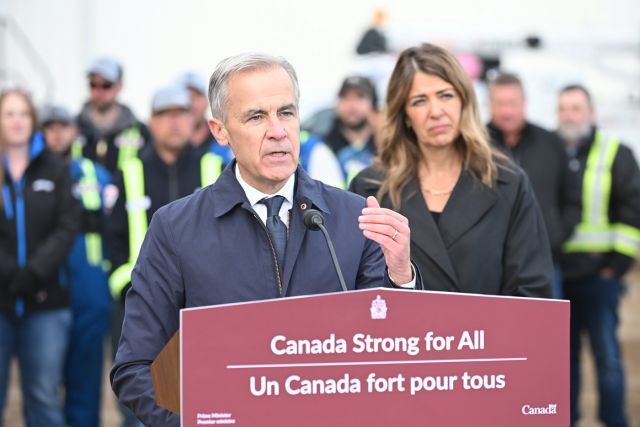
Prime Minister Mark Carney, who grew up in Alberta, spent the week leading up to the vote campaigning for the “stay” side. In a speech in Red Deer, Carney urged Albertans to reject the remaining nine questions, famously telling a Calgary crowd to “(Say) no to the nine.” He emphasized that Canada is not a transaction between provinces and that national unity is paramount. Carney’s campaign aimed to appeal to national pride and to secure a resounding result, even if the race was not considered close.
The referendum takes place against a backdrop of broader geopolitical and economic pressures. Carney is navigating combative trade talks with US President Donald Trump, who has previously suggested Canada should become the “51st state.” Maintaining national unity is a priority for Carney amid these external threats. In Quebec, the success of the separatist Parti Quebecois in recent local elections has kept the issue of national unity at the forefront of the political debate, even as polls suggest enthusiasm for independence there remains a minority cause.
Alberta, which is almost double the size of Germany in land mass, has a population of approximately 5 million, with half residing in its two main cities, Edmonton and Calgary. More than 1.3 million Albertans had already cast ballots by mail or in advanced polls before the official voting period began. Polls opened at 9 a.m. local time in Edmonton on Monday and were scheduled to close at 8 p.m., with results to be published as they come in.
The outcome will not be legally binding but will serve as a significant political signal. A strong rejection of the separation question and the accompanying constitutional demands could reinforce the federal government’s position, while a significant showing for separation could complicate future negotiations on fiscal federalism and immigration policy between Ottawa and Edmonton.