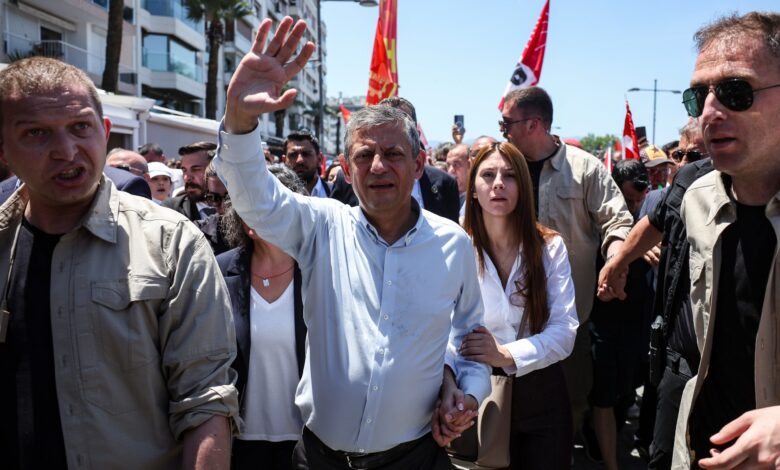
The court declared the 2023 party congress, in which Özel defeated Kemal Kılıçdaroğlu, null and void. The decision reinstates Kılıçdaroğlu, a 77-year-old party veteran who lost to Erdoğan in the May 2023 presidential election, as party leader and replaces the entire CHP executive board. The ruling, issued on Thursday, overturned a lower court decision from 2025 that had previously dismissed allegations of vote-buying irregularities during the primary. The immediate aftermath saw riot police deploy tear gas and water cannons against thousands of demonstrators who gathered outside the CHP headquarters in Ankara, some of whom refused to hand over the building to Kılıçdaroğlu’s administration.
Özgür Özel, who had emerged as a rising star in Turkish politics following the CHP’s sweeping victories in the 2024 local elections, condemned the decision as a “judicial coup.” “These coup plotters don’t come with tanks, cannons, rifles or camouflage; these coup plotters come in judges’ and prosecutors’ robes,” Özel stated, vowing to challenge the ruling in the Court of Cassation and before the Supreme Electoral Council (YSK). The CHP executive has rejected the court’s authority, and while rumors of a party split have circulated, Özel has denied plans to form a breakaway faction, asserting that “tenants leave, homeowners are to stay.”
The political opposition and international observers view this legal maneuver as part of a broader strategy to incapacitate the opposition. Senior CHP figures told Euractiv that the judicial interference is a signal that Erdoğan is preparing for snap elections. Under Türkiye’s constitution, an incumbent president is limited to two terms. However, the constitution stipulates that if early elections are called, the sitting president may run for a third and final term. With the next scheduled elections not due until 2028, a snap election would be the only constitutional pathway for Erdoğan to remain in power beyond his current mandate, provided he secures the necessary parliamentary backing.
Analysts suggest that the Erdoğan-led Justice and Development Party (AKP) may be able to secure the 360 parliamentary votes required to trigger early elections, potentially with support from smaller parties, while the CHP remains divided and legally embroiled. This tactic mirrors previous efforts to destabilize opposition functionality, such as the imprisonment of Istanbul Mayor Ekrem İmamoğlu, who is serving a sentence of over 2,000 years on corruption and criminal organization charges. Human Rights Watch has documented the use of Turkish courts to undermine the CHP’s ability to function as an effective opposition force.
The political standoff is occurring against a backdrop of significant economic strain and shifting geopolitical dynamics. Türkiye’s economy continues to grapple with high inflation, which the Financial Times reported the central bank adjusted its 2026 target to 24 percent, up from previous projections. The budget deficit for April 2026 reached TRY 338.7 billion (approximately €6.3 billion), nearly doubling from the same period a year earlier. These economic constraints limit Erdoğan’s ability to engage in populist spending, a factor CHP sources believe could widen the opposition’s electoral lead if elections were held under normal conditions.
Despite domestic authoritarian trends, Erdoğan’s international stature remains high, complicating efforts by Western partners to intervene. Türkiye’s strategic role in Syria, its mediation potential in the Iran-Israel conflict, and its growing influence in the post-Soviet space have made Ankara a critical partner for the United States and the European Union. U.S. President Donald Trump recently praised Erdoğan, stating, “He’s a strong man, but I have a relationship with him that nobody else has.” Speculation has arisen that the U.S. might offer a “dollar swap line” to stabilize Türkiye’s currency ahead of elections, a move that would implicitly support the current administration. Meanwhile, the European Union remains divided; while Commission President Ursula von der Leyen has grouped Türkiye with Russia and China as sources of negative influence, other EU states view Ankara as central to Europe’s defense architecture, particularly with a NATO summit scheduled for July in Ankara.
The closure of Istanbul’s independent Bilgi University, ordered by Erdoğan on Friday, further underscores the tightening grip on institutions critical of the government. Law professor Yaman Akdeniz described the shutdown of the 30-year-old institution as being done “overnight,” highlighting the disregard for academic freedom.
As the CHP prepares its legal objections and the Supreme Electoral Council reviews the case, the trajectory of Turkish democracy hangs in the balance. Erdoğan, who is 72 years old and reportedly in poor health, faces a succession question that is not just about policy but about the stability of Türkiye’s role as a regional middle power. Whether Erdoğan calls snap elections to exploit the current opposition turmoil, or whether the legal challenges succeed in restoring the 2023 leadership, the next formal step will likely be the Supreme Electoral Council’s decision on the CHP’s objection, which could determine the validity of the current party structure ahead of any potential early vote.