At the forefront of exoplanet science, researchers have moved beyond assuming that giant planets are perfect spheres. A study co-led by Cornell University and the University of Bristol, published in Nature Astronomy, presents the first application of a method known as “transmission strings” to map the atmosphere of WASP-17b. This “hot Jupiter,” located approximately 1,300 light-years from Earth, orbits close to its star, resulting in a permanent day side and a permanent night side. Previous modeling techniques typically extracted a single spectrum averaged over the entire edge, or limb, of the planet. However, Dr. Lili Alderson, the lead author and a Klarman Postdoctoral Fellow at Cornell who began her investigation at the University of Bristol, explained that the new technique allows researchers to distinguish different distances from the center to the edge of the planet.
“Rather than assuming your atmosphere is a circle with the same radius all the way around, our technique allows you to pull out different distances from the center to the edge of the planet,” Alderson stated. The data revealed that one side of WASP-17b’s atmosphere extends farther into space than the other, giving the planet an uneven, distorted outline. This bulge lies on the evening side of the planet, a pattern consistent with predictions of how heat and powerful winds shape worlds with extreme temperature gradients. Dr. Hannah Wakeford, an associate professor of astrophysics at the University of Bristol and co-author, noted the significance of applying this robust mathematical model to state-of-the-art data, describing the results as a “beautiful demonstration” of the multidimensional dynamics occurring in such atmospheres. This finding provides a direct observational constraint on the atmospheric structure of hot Jupiters, moving the field closer to creating accurate weather maps of distant planets.
In a separate but equally significant achievement, astronomers addressed the long-standing mystery of fast radio bursts (FRBs), millisecond-long flashes of radio emission whose origins have remained uncertain since their discovery in 2007. Most FRBs are detected only once, making them difficult to study. However, the MeerKAT telescope detected FRB 20240304B on March 4, 2024, with radio data suggesting it was extremely distant. To confirm this distance, the team required the identification of the host galaxy, a task that proved impossible for the world’s largest ground-based telescopes, which could not resolve any galaxy at that specific sky location.
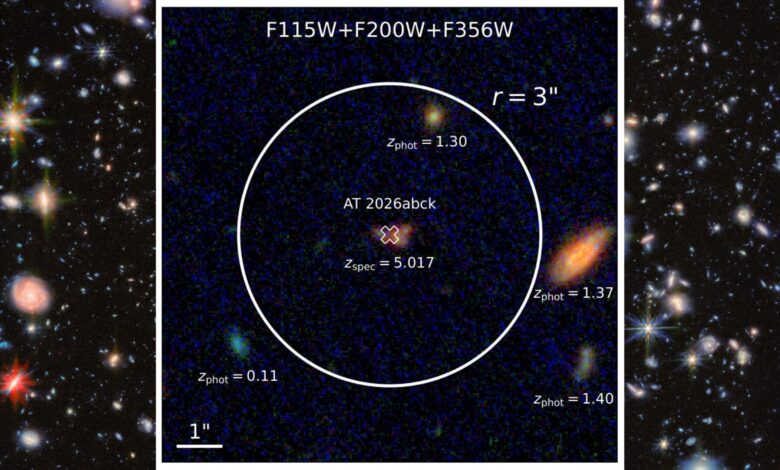
The team turned to JWST, whose Near-Infrared Camera (NIRCam) detected a galaxy at the precise coordinates of the burst. The Near-Infrared Spectrograph (NIRSpec) instrument then provided a precise redshift measurement of 2.148, placing the event just 3 billion years after the Big Bang. This finding was published in Science by Manisha Caleb of the University of Sydney and co-author Ben Stappers of the University of Manchester. The results challenged existing assumptions about the environments that generate FRBs. While the majority of known FRB host galaxies are massive and actively forming stars, the galaxy hosting FRB 20240304B was found to be 1,000 times less massive than expected.
“We thought it would be a big, nicely formed galaxy with lots of stars, and instead it was a little dwarf galaxy, although it was actively forming stars,” Caleb observed. This discrepancy suggests that the mechanism producing these energetic bursts may not be strictly tied to the presence of massive stellar populations or specific galactic morphologies. The finding expands the potential range of environments where FRBs can occur, complicating theoretical models that link these bursts exclusively to massive star-forming regions.
These discoveries occur within a broader context of JWST’s operational capabilities, which include measuring the Hubble Constant to resolve the “crisis in cosmology” and probing early dust formation via stripped-envelope supernovae. For instance, researchers like Barry Madore and Wendy Freedman are using the telescope to measure the expansion rate of the universe, aiming to reconcile conflicting results from different measurement methods. Similarly, other programs are investigating the chemical abundances of quiescent galaxies and the nature of “Little Red Dots,” which some research suggests may be overfed black holes wrapped in their own fuel.
The synthesis of these findings highlights the telescope’s ability to bridge the gap between detection and detailed physical understanding. In the case of WASP-17b, the distortion of the atmosphere provides a tangible metric for atmospheric dynamics, while the identification of the dwarf galaxy host for FRB 20240304B forces a re-evaluation of the progenitors of high-energy cosmic events. The next stage of research must address whether the low-mass host galaxy is an anomaly or part of a broader population of FRB hosts that current surveys have missed due to their faintness. As JWST continues to operate, including in its Cycle 4 observations, the distinction between theoretical prediction and direct observational evidence becomes increasingly sharp, allowing scientists to refine models of both planetary atmospheres and the early universe with greater precision.