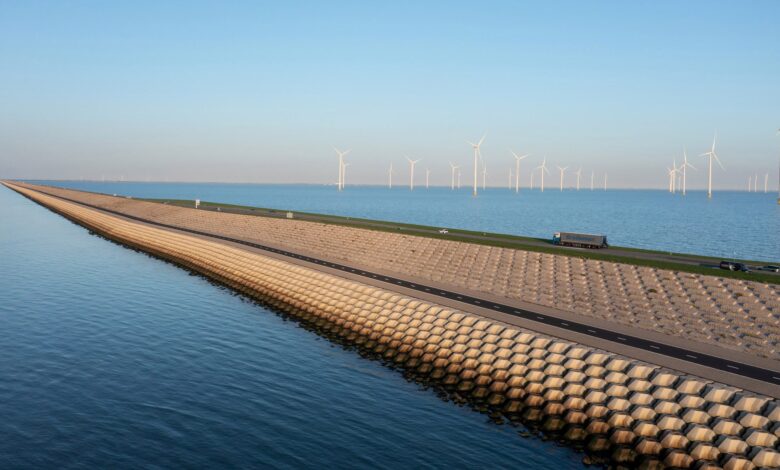
Recently, the dam underwent a significant overhaul by Dutch studio Benthem Crouwel, in collaboration with construction company BAM and contractor Van Oord. The project, which began in 2018, was driven by the need to align the century-old structure with current safety standards and improve its performance against increasingly extreme weather and rising sea levels. The primary objective was to ensure the dam can withstand a severe one-in-10,000-year storm while preserving its iconic character and long, linear form.
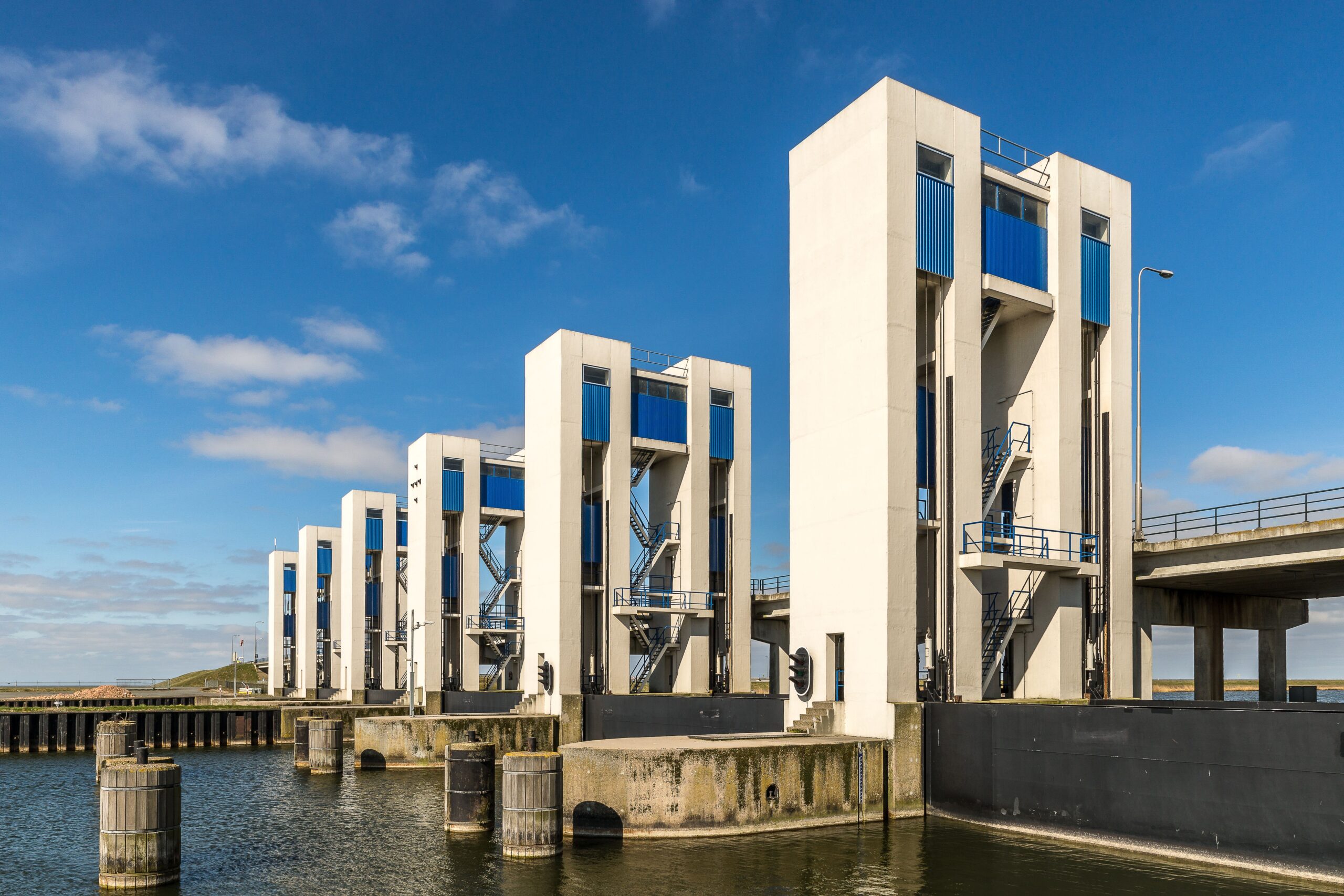
The technical execution of this revamp involved reinforcing the entire length of the structure with 75,000 interlocking concrete blocks known as Levvel-blocs. These blocks are arranged in a deliberately symmetrical and regular pattern and finished with rough surfaces that allow marine vegetation to latch on, integrating ecological function with structural integrity. The dam was raised by two metres to provide additional protection. Additionally, the team introduced additional pumping stations, discharge sluices, storm surge barriers, and a cycle path. A key ecological addition was a passage for migratory fish, addressing the barrier the dam once posed to aquatic life.
“The Afsluitdijk is one of the Netherlands’ most iconic waterworks and a landmark of Dutch water engineering,” explained Daniel Jongtien, studio partner at Benthem Crouwel. “The significance of the Afsluitdijk is huge on many levels. It was built in the 1930s to close off the former Zuiderzee, creating the IJsselmeer and fundamentally changing how the country manages water.” Jongtien noted that the brief was to strengthen the iconic and monumental character of the Afsluitdijk without losing sight of its primary function. The studio’s overarching goal was simplicity, ensuring that any visible elements reveal how the infrastructure works and enhance the experience of the site.
The revamp has not only improved physical resilience but also attracted international attention, most recently from Prime Minister Narendra Modi of India. During his official trip to the Netherlands, Modi visited the Afsluitdijk alongside Dutch Prime Minister Rob Jetten. The visit underscored the shared commitment of both nations to innovative water management solutions, climate resilience, and sustainable infrastructure. For India, the trip highlighted a strategically important issue: long-term water management and climate resilience in the face of changing environmental conditions.
The visit placed the spotlight on the parallels between the Afsluitdijk and India’s ambitious Kalpasar project in the state of Gujarat. The Kalpasar project aims to create a freshwater reservoir across the Gulf of Khambhat, integrating tidal power generation, irrigation, and transportation infrastructure. Recognizing the potential for knowledge transfer, the two sides welcomed the signing of a Letter of Intent between the Ministry of Jal Shakti of India and the Ministry of Infrastructure and Water Management of the Netherlands for technical cooperation on the Kalpasar project.
The leaders noted that Dutch expertise in hydraulic engineering and India’s scale of implementation present opportunities for mutually beneficial partnerships. This move reaffirms the India-Netherlands Strategic Partnership on Water, highlighting a shared commitment to innovation and sustainability. The Netherlands has done pioneering work in water resources, and the global community is increasingly looking to these models for guidance on managing flood risks and securing freshwater supplies.
As the Afsluitdijk continues to serve its role in protecting the Netherlands from the North Sea, its recent upgrades stand as a testament to the evolving nature of climate adaptation. The collaboration between the two nations suggests that the lessons learned from this 1930s landmark are being applied to new, large-scale projects, addressing the critical need for resilient infrastructure in a warming world. The next verified development in this partnership will likely focus on the technical implementation of solutions derived from the Afsluitdijk’s recent renovation for the Kalpasar project.