
The study, led by Mark Hollands, an astrophysicist at the University of Warwick in England, was published in the journal RAS Techniques and Instruments (RASTI). By analyzing the spectra of 151 white dwarf stars within 20 parsecs (approximately 65 light-years) of Earth, the team discovered that these dense objects can exhibit a wide range of colors, including pink, purple, cyan, yellow, and green. This is a significant departure from the “perfect radiator” model, which posits that stellar color is set almost entirely by temperature.
“Most stars, including most white dwarfs, behave like ‘perfect radiators,’ so their colour is set almost entirely by temperature,” Hollands said. “But nobody had really looked into what else might be possible for white dwarfs. It turns out these incredibly dense stars can produce colours nobody expected, and some of them genuinely surprised me.”
The Physics of Color in Dense Atmospheres
The key to these unusual colors lies in the extreme density of white dwarf atmospheres. While the atmospheres of normal stars are relatively thin, the outer layers of the coolest white dwarfs can reach densities of about 1 gram per cubic centimeter—roughly equivalent to the density of water and millions of times denser than the photosphere of the Sun.
Under these high-density conditions, trace elements such as carbon, calcium, and sodium interact with the surrounding helium plasma in ways that do not occur in less dense environments. These interactions cause the elements to absorb a wider range of wavelengths than they would at lower densities, shifting the star’s perceived color away from the standard thermal spectrum.
Because no white dwarf is close enough to be photographed in its true color, the researchers calculated these hues by running spectral data through a computer model of human color vision. This method translates the “fingerprint” of starlight—its spectrum—into the specific wavelengths the human eye would perceive if the star were visible to the naked eye.
WD J1330+6435: The First Green Star
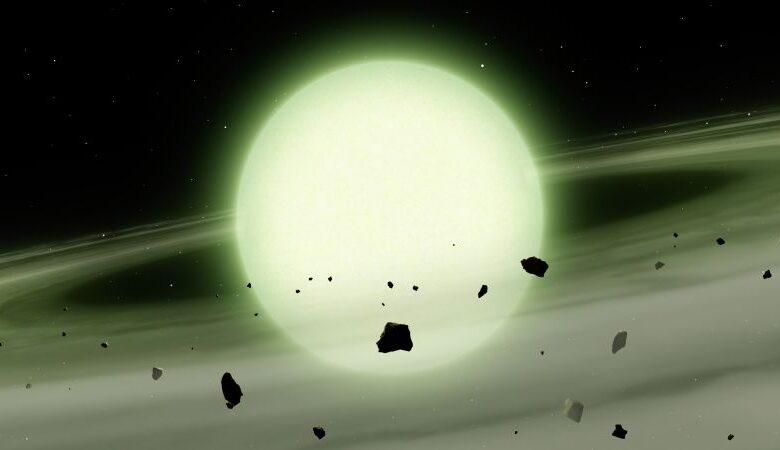
The most striking finding is the identification of WD J1330+6435, located approximately 284 light-years from Earth. This star, with a temperature of about 4,000°C (7,232°F), appears chartreuse green in the researchers’ models. The coloration is attributed to the presence of rocky debris from a former planetary system that has been accreted onto the star over time.
Adam Burgasser, a professor of astronomy and astrophysics at the University of California San Diego, who was not involved in the study, compared the process to a crime scene investigation. “The white dwarf is taking apart the planets, and we’re able to see what was actually inside that planet — the proportion of the different elements — and that gives us clues in how these planets were formed,” Burgasser said.
Specifically, traces of sodium in the atmosphere of WD J1330+6435 absorb the orange portion of the spectrum, leaving behind a “ghostly green glow,” Hollands explained. To date, no other star, living or dead, has been credibly reported as green, making this a unique observational milestone.
The Reddest Star and Color Misconceptions
On the opposite end of the spectrum, the team identified WD J1011+2845, located just 48 light-years from Earth, as potentially the reddest star ever recorded. This white dwarf possesses a deep convection zone that has lifted carbon from its core to its surface. The resulting carbon molecules distort the star’s light, squeezing almost all emission into wavelengths beyond 600 nanometres, producing a deep salmon-pink hue.
The study also addresses a common misconception in astronomy: that white dwarfs are typically blue. In reality, blue-white dwarfs are hotter and brighter, making them easier to detect in surveys that rely on brightness rather than proximity. By analyzing a representative sample of nearby stars, the researchers found that the median color temperature of the 146 standard white dwarfs in their sample was approximately 6,800 Kelvin. To the human eye, this appears as white.
“One in thirty might not sound like a huge fraction, but across the entire population of white dwarfs in the Universe, that is still a lot of oddly coloured stars out there,” said Boris Gänsicke, a co-author and astronomer at the University of Warwick. “Yet if we take the median across a representative population of white dwarfs, we found that the average white dwarf really is white.”
Implications and Future Research
While the visual colors are striking, the scientific value lies in the atmospheric composition they reveal. The study categorizes white dwarfs into distinct color groups linked to their chemistry: carbon-rich stars tend to be pink or purple; stars enriched with asteroid debris are often yellow; and cooler stars with mixed hydrogen and helium atmospheres appear cyan or pale blue.
Agnès Kim, an astrophysicist at Penn State Scranton, noted that while the observations are based on existing data, the approach offers a new perspective. “Doing a study that goes from spectrum to what the human eye would see is a cool intersection of physics and biology to me,” Kim wrote in an email. “I love that some would look green to us if they were close enough for us to see them, and even more fun that some would look pink.”
The findings could have broader implications for understanding planetary formation. By using white dwarfs as “diagnostic tools” to measure the chemistry of accreted rocky material, astronomers can infer the composition of planets that existed billions of years ago. Hollands plans to extend this analysis to a larger sample of stars. With upcoming spectroscopic surveys, he expects a tenfold increase in the number of white dwarfs with available spectral data, potentially revealing 10 to 20 more green or otherwise unusually colored stars in the nearby universe.