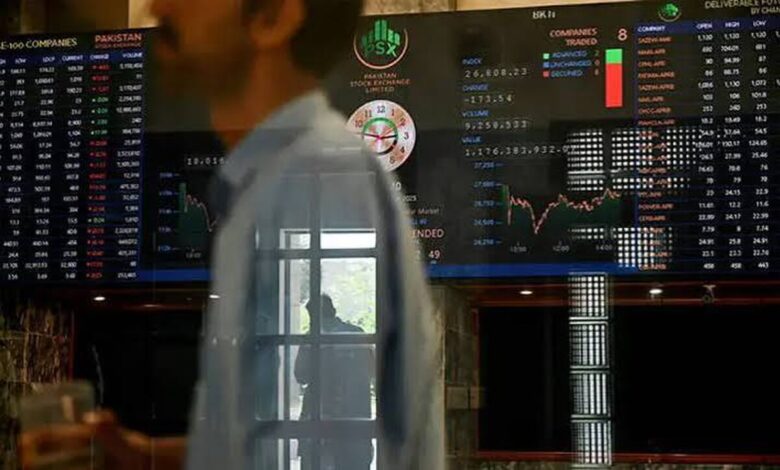
The rally was not confined to a single sector but was characterized by broad-based participation across the market. Buying interest was particularly prominent in the cement, automobile, and banking sectors, with specific tickers such as FCCL, MLCF, GAL, GHNI, PIBTL, and CNERGY drawing attention amid earnings announcements and improved profitability. Topline Securities, a brokerage house, noted in its post-market report that renewed buying interest persisted despite the State Bank of Pakistan’s recent decision to raise its policy rate by 50 basis points. The firm attributed the market’s upward momentum to this domestic demand, coupled with easing international crude oil prices.
Heavyweight stocks played a pivotal role in lifting the index. MCB, FFC, UBL, PPL, and NBP were identified as major contributors, collectively adding approximately 490 points to the benchmark. This concentration of gains in large-cap financial and energy stocks provided the structural support needed to sustain the rally. Volume on the all-share index increased to 401.97 million shares from 376.02 million in the previous close, while the value of shares traded rose to Rs 18.07 billion from Rs 16.19 billion. Out of the 497 companies traded on Tuesday, 282 registered an increase, 170 recorded a fall, and 45 remained unchanged, indicating a generally positive sentiment across the broader market.
Domestic drivers, however, did not operate in isolation. The PSX advance coincided with a significant uptick in global risk appetite, particularly in Asian markets. South Korea’s KOSPI index gained more than 4% in early trading, while Japan’s Nikkei was 1.9% higher. MSCI’s broadest index of Asia-Pacific shares outside Japan rose 1.2%. This regional surge was largely attributed to developments in the technology sector, specifically the US initial public offering (IPO) filing by Anthropic, the creator of the Claude AI model. Anthropic disclosed steep losses alongside rapid revenue growth in its filing, a move that investors are interpreting as a critical test for the profitability of massive AI spending. Additionally, Meta Platforms’ plan to raise as much as $95 billion in its largest-ever equity fundraising further boosted sentiment.
Global investors are also awaiting decisions from major central banks, including the Federal Reserve, the European Central Bank, and the Bank of Japan. Economists generally expect these institutions to maintain their current interest rates, shifting the focus to policymakers’ comments on the future rates outlook. In this context, currency markets remained relatively muted. In Pakistan, the rupee continued its marginal gain against the US dollar in the inter-bank market, closing the day at 276.80, a gain of just Rs 0.01 against the greenback. Meanwhile, Nasdaq futures rose 0.4% after US chip stocks jumped 2.8% in overnight trade, marking their biggest one-day gain in a month, whereas European stock futures dipped 0.23%.
The interplay between local fundamentals and global tech optimism creates a complex backdrop for Pakistani equities. While the SBP’s 50bps rate hike is traditionally a headwind for equities by increasing borrowing costs, the market’s resilience suggests that other factors—such as improved corporate profitability in key sectors and favorable global sentiment—are currently outweighing the monetary tightening. The fact that the index reached new intra-day highs despite the rate hike indicates that investors are pricing in sustained economic recovery or sector-specific growth prospects.
Looking ahead, the next few sessions will likely be influenced by the continuation of this global tech-driven rally and the specific earnings reports from the heavyweights that drove Tuesday’s gain. For now, the KSE-100 has established a stronger footing, with the 164,000 level acting as a recent support-turned-resistance zone. The market’s ability to absorb the rate hike while capitalizing on global AI enthusiasm suggests a maturing local equity market, one that is increasingly responsive to both domestic corporate performance and international capital flows.