
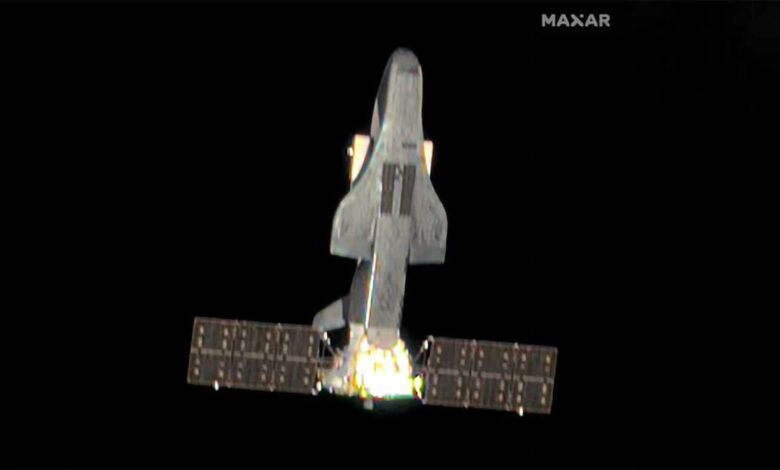
The Shenlong, also referred to in some contexts as the OTV (Orbital Test Vehicle) program, represents a significant step in China’s spaceflight capabilities. According to the DIA, the vehicle has completed four missions since its debut in 2020. The initial flight in 2020 served as a prototype test, remaining in orbit for two days before reentry. Subsequent missions have demonstrated increasing duration and complexity: the second mission, launched in August 2022, remained in orbit for 276 days, while the third mission in December 2023 lasted 268 days. The fourth and current mission began on February 7, 2026, with a launch from the Jiuquan Satellite Launch Center.
The significance of the Shenlong lies not just in its reusability, but in its demonstrated ability to interact with other objects in orbit. The DIA report highlights reported rendezvous and proximity operations (PROPs) during the second and third missions. In November 2022, during the second mission, the spaceplane was observed maneuvering with a companion satellite, at one point appearing within 100 meters of the other object. Observers noted that the two objects possibly rendezvoused before the satellite was re-released. Similar activity was recorded during the third mission, where the vehicle released and interacted with an object.
Independent verification of these activities has come from commercial space intelligence firms. In June 2026, LeoLabs, an American space intelligence company, reported detecting a new object near the Shenlong during its current fourth mission. Using its global tracking network and analysis via LeoLabs Delta, the company stated it had “independently cataloged this object and assessed with high confidence that it was released from the Chinese space plane.” LeoLabs noted that this activity is consistent with sub-satellite deployments conducted during previous missions. These proximity operations involve two spacecraft maneuvering close to one another, a technology used for inspection, servicing, or interaction with satellites. While such capabilities have clear peaceful applications, such as satellite servicing, they also possess potential military utility, including the ability to capture or disable adversary assets.
Beijing has maintained that the program is for peaceful purposes. In statements regarding the missions, Chinese authorities have described the spacecraft as a “test spacecraft” intended to verify “reusable and in-orbit service technology” to “provide technical support for the peaceful use of space.” However, the DIA report contextualizes these activities within China’s broader national military strategy. The agency states that China identifies space as a strategic priority for military dominance and political influence, emphasizing “active defense” which pairs strategic defense with operational and tactical offense. The DIA warns that China “has developed and will continue to advance weapons for use against satellites in orbit to disrupt, damage, and destroy other nations’ space capabilities.”
The release of this imagery and the detailed assessment of the Shenlong’s operations come against a backdrop of escalating tensions in space. The report also reviews the capabilities of other adversaries, including Russia, Iran, and North Korea, but the Shenlong stands out due to the level of direct visual and tracking evidence available. The ability to distinguish between benign servicing operations and potential anti-satellite (ASAT) or inspection capabilities remains a challenge for intelligence analysts. While there is no confirmation that the Shenlong has been used to interfere with or damage other spacecraft, the consistent pattern of releasing objects and performing close-proximity maneuvers suggests a maturing operational capability.
The distinction between laboratory or simulation results and real-world orbital performance is critical here. The Shenlong’s missions provide real-world data on its maneuverability, fuel efficiency, and interaction protocols in the demanding environment of low Earth orbit. The fact that the vehicle has completed multiple long-duration missions, including one exceeding 270 days, demonstrates a high level of reliability and control. The inclusion of the Maxar (now Vantor) image in the DIA report serves to corroborate the technical specifications and operational status of the vehicle, moving the discourse from speculation to evidenced assessment.
As China continues to advance its spaceplane technology, the international community faces the challenge of monitoring these activities. The capability to conduct rendezvous and proximity operations is a dual-use technology with significant implications for both commercial space sustainability and military security. Future missions will likely provide further insights into the specific payload and operational intent of the Shenlong. For now, the combination of official Chinese statements regarding peaceful use and the independent tracking data confirming complex orbital maneuvers creates a picture of a sophisticated, active, and increasingly ubiquitous presence in low Earth orbit.