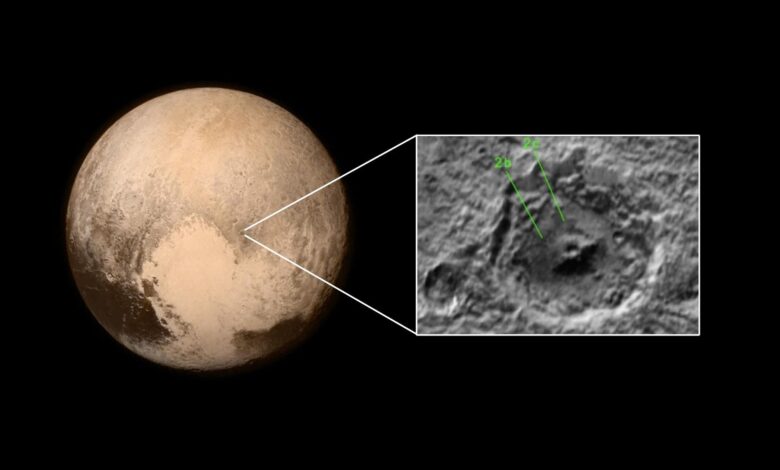
The research was led by geologist Marco Emanuele Discenza, who analyzed data from the Long-Range Reconnaissance Imager (LORRI). The instrument was capable of resolving surface features as small as 300 meters (984 feet). The team found convincing evidence for these six landslides occurring down the inner walls of three craters located on the western edge of Sputnik Planitia, the large heart-shaped region on Pluto’s surface.
The mobility of the debris is attributed to Pluto’s low gravity and the low-friction nature of the icy rubble. The study notes that the aftermath of these landslides was visible in the flyby imagery, confirming that geological processes are ongoing, albeit on long timescales. This observation distinguishes itself from static geological features, offering a dynamic view of the dwarf planet’s surface evolution.
While the primary focus is on the landslide mechanics, the data also reinforces the complex geology of Sputnik Planitia. Previous analyses of the same New Horizons dataset have noted that the glacier contains heat convection cells, polygonal shapes at least 10 kilometers (6 miles) across, which indicate internal heat escaping from beneath the ice. These features, along with the presence of water-ice blocks rising through nitrogen ice, further illustrate the active nature of Pluto’s surface.
The discovery of these landslides adds to the broader understanding of Pluto’s environment, which includes a thin atmosphere driven by the sublimation and condensation of nitrogen ices. While the landslide study focuses on solid-state geophysics, it complements other observations such as dune fields and atmospheric circulation patterns, painting a picture of a world with active physical processes despite its distance from the Sun.
The results provide a baseline for understanding how low-gravity environments affect mass wasting events. The study does not claim these landslides are unique to Pluto but highlights their extreme mobility relative to other solar system bodies. Future analysis may focus on the specific composition of the landslide deposits to better understand the friction coefficients of Pluto’s surface materials.