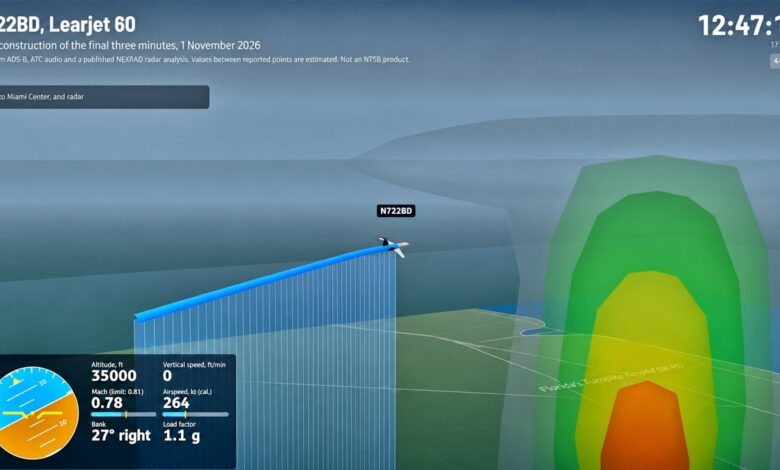
According to recordings from the Miami Air Route Traffic Control Center, the crew reported “light, clear ice that is manageable and moderate turbulence” shortly before the incident. The pilot also noted an outside air temperature of minus 47 degrees Celsius, a figure indicative of the extreme cold typically found at the aircraft’s cruising altitude of 35,000 feet. The situation escalated quickly. After reporting precipitation, the pilot requested permission to climb to 37,000 feet to escape the deteriorating conditions. This request was followed immediately by an emergency declaration. “We’re descending 8,000 – mayday, mayday – we’re descending 10,000 feet per minute,” the pilot radioed. Within moments, the descent rate accelerated to 20,000 feet per minute, and eventually to 30,000 feet per minute, a rate that exceeded the aircraft’s design limits and pushed it into an overspeed condition. The pilot warned, “We’re going to crash into the ground,” before the aircraft banked sharply to the right and impacted the earth.
The meteorological context suggests the aircraft encountered a rapidly intensifying weather system. Weather maps from the period show extensive cloud cover and precipitation across Florida, with clusters of stronger thunderstorms over the Gulf of Mexico, the state’s west coast, and parts of southern Florida. A preliminary analysis by meteorologist Matthew Cappucci, published by MyRadar, indicates that a developing thunderstorm was present near the aircraft’s location shortly before the crash. The storm’s cloud tops grew from just under 33,000 feet to approximately 48,300 feet in roughly 20 minutes. This rapid vertical growth is a sign of powerful atmospheric updrafts, which can generate the severe turbulence and icing conditions reported by the crew. The turbulence was significant enough to cause altitude deviations of up to 700 feet, jolting the aircraft violently.
Florida Governor Ron DeSantis, who visited the scene, described the event as a “cataclysmic plane crash,” noting that it “looked like a missile going down.” He stated that there were no immediate reports of injuries or deaths on the ground, despite the crash landing only feet from homes and inches from passing vehicles. The impact caused significant damage to local infrastructure, with some roads expected to remain closed for an extended period. Thick black smoke engulfed the site, with flames flickering around chunks of pavement lining the crater. Transportation Secretary Sean Duffy confirmed the fatalities and described the event as a “horrific tragedy.” He announced that the Federal Aviation Administration (FAA) was sending a team to support the National Transportation Safety Board (NTSB) in its investigation.
The convergence of icing, turbulence, and rapid storm development presents a complex engineering challenge for investigators. The “light, clear ice” reported by the pilot is distinct from rime ice; clear ice is transparent and can accumulate on the leading edges of wings and control surfaces, altering the aerodynamic profile of the aircraft. At an outside air temperature of -47°C, the moisture in the air is in a supercooled state, capable of freezing instantly upon contact with the airframe. If the ice accumulation exceeded the “manageable” level reported, or if the turbulence disrupted the airflow over the wings, the aircraft could lose lift. The subsequent overspeed condition, where the aircraft exceeded its maximum safe velocity, suggests a loss of control or a structural response to the aerodynamic forces at play. The rapid descent rate of 30,000 feet per minute is far beyond the capabilities of standard emergency procedures, indicating that the aircraft likely entered a spin or a deep stall that could not be recovered from.
While the meteorological data provides a plausible backdrop for the incident, it does not yet confirm a direct causal link to a specific thunderstorm cell, though the proximity of the rapidly growing storm is a key focus of the analysis. The NTSB investigation will likely examine the flight data recorder and cockpit voice recorder to determine the exact sequence of events, including whether the pilots were able to activate anti-ice systems effectively and how the aircraft responded to the turbulence. The incident highlights the persistent risks of operating in complex weather environments, where conditions can change on a minute-by-minute basis. For now, the community in Greenacres remains in shock, dealing with the physical aftermath of the crash and the emotional weight of a tragedy that unfolded in the clear skies above, only to end in a fireball on the ground.