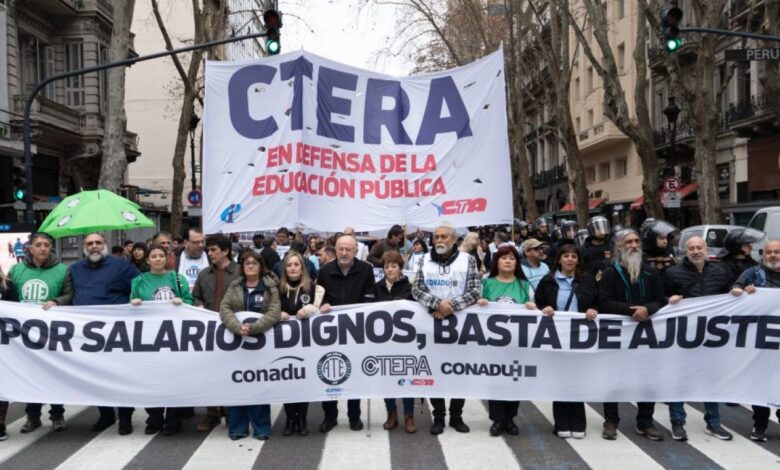
The strike was called in response to what organizers described as an “adjustment on public education” and a lack of response from the national government. Key demands included the urgent implementation of the National Teachers’ Paritaria to ensure salaries keep pace with the cost of living, the restitution of the FONID fund, and the transfer of national education funds owed to provinces. Educators also called for a new Law on Educational Financing, the defense of teacher pensions, and the rejection of the Educational Freedom Bill, which they argued seeks to defund public schools.
David Edwards, General Secretary of Education International (EI), issued a support letter stating that the organization would address the International Labour Organization (ILO) regarding the “brutal onslaught against the teaching profession by the government of Javier Milei.” Edwards alleged that the Argentine government violates ILO Conventions 87 and 98 on freedom of association. The Education International Latin America Regional Committee echoed these concerns, urging authorities to refrain from applying administrative sanctions or fines against unions for organizing or participating in the strike.
Protests centered on a massive mobilization in front of the Ministry of Economy, where demonstrators demanded policies guaranteeing the social right to education. The action followed weeks of sustained pressure, including weekly Wednesday demonstrations by pensioners and leftist political groups in front of the national congress. These earlier protests, which included members of the PTS-FIT party, were reportedly met with police repression, a factor cited as exacerbating public discontent with the administration.
While the strike was widely observed, sources note that the General Confederation of Labour (CGT) did not organize the action from a bottom-up perspective, and the drivers’ union (UTA) effectively boycotted the event. Despite this, the strike disrupted trains, subways, hospitals, and industrial production, with reports indicating 90 percent of the labor force at Ford’s Pacheco facility halted work. The event marks a significant escalation in labor resistance against the government’s austerity measures, with international unions framing the conflict as a broader issue of workers’ rights and public education funding.