While Xi’s speech framed reunification as a “peaceful” process and an “unwavering historical mission” of the Communist Party, the message was hard to miss to the island’s government. The Mainland Affairs Council in Taipei swiftly rebuffed the remarks, with spokesperson Liang Wen-chieh noting that the wording was not significantly different from previous assertions. The Taiwanese government reiterated that neither the state nor its people could accept the “one country, two systems” model proposed by Beijing, viewing it as a path to submitting to the rule of the Chinese Communist Party. “We will never leave any room for ‘Taiwan independence’ separatist activities in any form,” Xi added, emphasizing that all Chinese, including those in Taiwan, should jointly oppose forces he labeled as separatist.
The diplomatic friction is unfolding against a backdrop of intensified military posturing that has drawn concern from international partners. Although Xi stopped short of explicitly mentioning the use of military force in his address—a point of note given that Beijing has never formally renounced the use of force against the island—the physical reality of the region is increasingly defined by Chinese military presence. According to Taiwan’s defense ministry, 29 Chinese military aircraft, including J-16 fighter jets and drones, were detected conducting a “joint combat readiness patrol” around the island in conjunction with warships on Thursday.
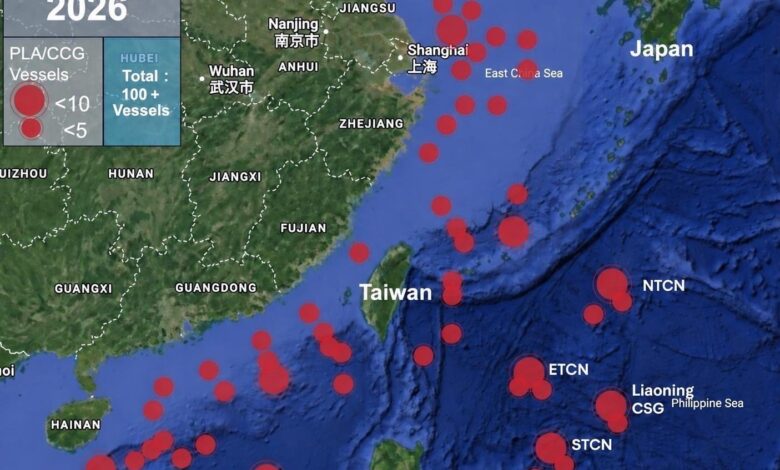
This daily military activity is part of a broader strategic evolution. Last week, the People’s Liberation Army (PLA) conducted massive naval exercises spanning the South China Sea, East China Sea, and the Philippine Sea. These maneuvers were not merely symbolic; they appear to be structured around an “area denial” strategy. Joseph Wu, secretary general of Taiwan’s National Security Council, reported that more than 100 PLA Navy and China Coast Guard ships were at sea for the unannounced exercise. The fleet was divided into two primary groups: one moving out into the Pacific to accompany the Chinese carrier Liaoning, and a second encircling the shores of Taiwan to create a naval cordon. Additional task forces were deployed to cover China’s main seaports and southern approaches.
Western intelligence and analytical bodies have closely monitored these shifts. The U.S.-based Institute for the Understanding of War (ISW) assessed that the scope and location of the drills suggested “a major exercise that simulates isolating Taiwan.” The ISW noted that the involvement of naval units from all three of the PLA’s coastal divisions—the Eastern, Northern, and Southern Commands—marked a departure from standard procedure. It is unusual for China to conduct a coastwide drill of this magnitude without prior announcement; the last such coastwide drill occurred in mid-October. American and allied military planners have long anticipated that a Chinese offensive would be accompanied by efforts to restrict access to the region, preventing foreign intervention by intercepting everything from merchant ships to carrier strike groups.
The geopolitical stakes are further elevated by the timing of these events. Xi’s speech comes just one week ahead of the APEC summit in Shenzhen, where he is expected to meet with U.S. President Donald Trump. The summit offers a potential venue for diplomatic engagement, yet the simultaneous display of naval power suggests a strategy of maintaining pressure while keeping diplomatic channels open. The G7 foreign ministers have also weighed in, stating that China’s actions east of Taiwan threaten regional stability.
For the global economy, the implications of this tension are complex. While the sources do not detail specific trade disruptions or supply chain impacts arising from these specific exercises, the strategic focus on “area denial” and the isolation of Taiwan highlights the vulnerability of maritime routes in the region. The presence of a naval cordon and the deployment of strike aircraft and antiship missiles indicate a capability that could disrupt commercial shipping if tensions escalate. The “One China” policy remains the framework through which the majority of the international community recognizes mainland China, though many nations maintain unofficial economic and cultural ties with Taiwan, a self-governed and democratic entity.
As the world watches the upcoming APEC summit, the contrast between Xi’s rhetoric of “peaceful reunification” and the military preparations for isolation remains stark. The Taiwanese government has firmly rejected the premise of reunification under Beijing’s terms, while international observers analyze the naval drills as a rehearsal for potential conflict. The next critical juncture will be the outcome of the talks between Xi and Trump in Shenzhen, where the balance between diplomatic dialogue and strategic deterrence will be tested.
For now, the 160th anniversary of Sun Yat-sen serves as a reminder of the unresolved political legacy that continues to define the relationship across the Taiwan Strait. The “tide of history,” as described by Beijing, is met with a firm rejection by Taipei, leaving the future of the island’s status as a central point of contention in international affairs.