
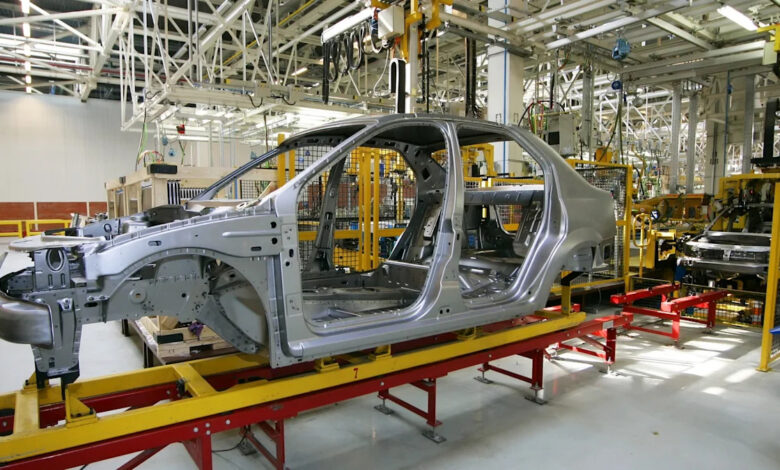
The dispute centers on Stellantis’ agreement to sell the idled Brampton facility to Roshel, a Canadian armored vehicle maker. According to reporting by CTV, Stellantis intends to lease back part of the plant from Roshel to assemble Chinese electric vehicles (EVs) using knock-down kits. In this model, vehicle parts are shipped from China, with only final assembly occurring in Canada. Ontario Premier Doug Ford has strongly opposed this arrangement, arguing in a letter to Prime Minister Carney that it undermines the future of the Ontario automotive sector. Ford warned that allowing the introduction of Chinese-made knock-down kits puts more than 75,000 jobs at risk, citing the broader threat posed by Chinese EV competition to manufacturing hubs in South America and Europe.
Stellantis announced the shift in production strategy on October 15, 2025, moving vehicle production from Brampton to the United States. The company’s decision aligns with its broader “FaSTLAne 2030” product plan and a “hard cost reset” aimed at supporting adjusted operating income and cash flow amidst regional pressures, tariffs, and labor risks. Analysts have noted that closing an idled site and selling assets is consistent with the footprint rationalization emphasized in Stellantis’ Value Creation Program, particularly as the company faces headwinds from tariff costs and electric vehicle margin pressure.

However, the legal footing of the government’s threat rests on a 2022 funding agreement between Stellantis and the federal government, under which the automaker received at least $220 million for its facilities in Brampton and Windsor, Ontario. A partially redacted copy of the agreement obtained by CBC News suggests that Stellantis may have contractual protections. A provision added in 2023 states that closing the Brampton plant before 2035 would constitute a violation only if the closure was forced by circumstances beyond the automaker’s “reasonable control” that made the facility “commercially unviable,” and if Stellantis failed to provide “substantial evidence” that it had taken all reasonable commercial efforts to secure alternative mandates for the plant.
This clause has become a focal point of political and legal scrutiny. Conservative MP Harb Gill, the shadow minister responsible for the auto sector, questioned the ambiguity of the “reasonable control” language. He argued that Stellantis might cite the U.S. trade war and tariffs as external pressures, but noted that the company is still producing and selling the same products, merely shifting the location of production from Canada to the United States. “Tell us how it’s not viable because you’re still producing or you’re just moving production from Canada to the U.S. and you’re still selling the same product,” Gill stated.
The dispute has also drawn criticism regarding the federal government’s role in the negotiations. A Toronto Sun op-ed alleged that while publicly criticizing the sale, the Carney government was involved in the talks and continues to court Chinese EV makers, potentially increasing risks to Canadian auto jobs. The article highlighted that Stellantis’ move reflects a broader trend of production shifting south to the U.S. during President Donald Trump’s trade war, a dynamic that has complicated supply chain strategies for multinational automakers.
Unifor, the union representing Brampton workers, has accused Stellantis of violating its collective agreement and prior commitments tied to public funding. The union and local officials warn that the sale poses risks to thousands of auto jobs and local suppliers. While Stellantis’ management frames the decision as a necessary strategic adjustment to maintain profitability in a volatile global market, Canadian officials maintain that the automaker has failed to honor its obligations to the nation that provided significant public capital for the facility’s operation.
The 30-day window for Stellantis to respond to the formal notice is now the immediate next step in this dispute. The outcome will depend on whether the automaker can demonstrate, to the satisfaction of Canadian regulators, that the shift in production was driven by factors beyond its reasonable control and that it exhausted all other commercial options for the Brampton site. The resolution of this case may set a precedent for how public funding conditions are enforced against multinational corporations in the context of shifting global trade policies.



One Comment