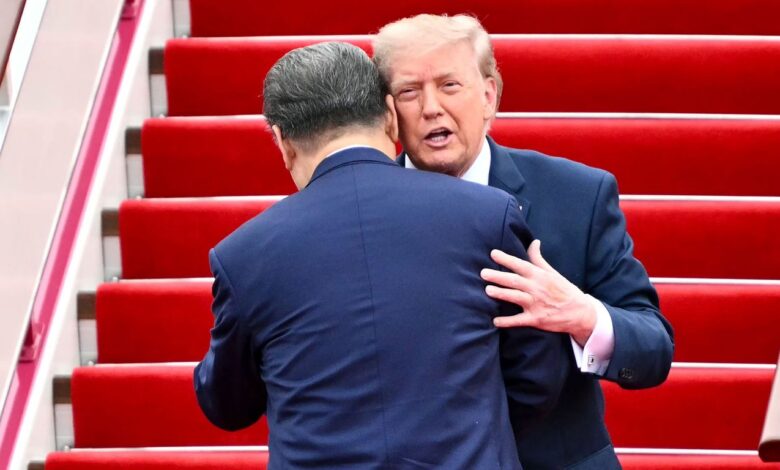
The gesture in Shenzhen is a deliberate reciprocation of a similar honor Trump extended in September 2025. During Xi’s state visit to Washington D.C., Trump met the Chinese leader at the bottom of the jet’s stairs at Joint Base Andrews, bypassing the customary White House reception. By mirroring this act, Xi signaled a distinct shift in the tone of bilateral relations, even as the two nations entered a complex multilateral environment. The scene at the airport was marked by high visibility: dozens of performers waved pom-poms on a red carpet, chanting and cheering, while fighter jets flew overhead, leaving colorful vapour trails. Both national anthems were played, and Xi told Trump, according to Xinhua, that he looked forward to an “in-depth exchange of views” on China-US relations, Asia-Pacific cooperation, and the global landscape.
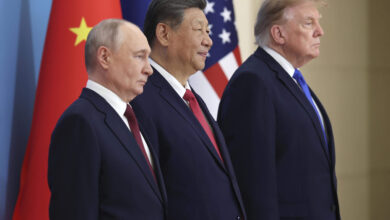
This diplomatic overture serves as the prelude to a historic and unprecedented trilateral summit scheduled for Thursday, bringing together the leaders of the United States, China, and Russia. It is the first time the heads of state of these three nations, which possess the world’s largest nuclear arsenals, have convened for such a meeting. The summit is being held in the context of the annual Asia-Pacific Economic Cooperation (APEC) forum, a regional group of 21 economies around the Pacific rim, where all three leaders also attended a dinner alongside other regional heads of government on Wednesday night.

However, the warm atmosphere on the tarmac contrasts with the starkly different agendas the leaders are bringing to the table. The economic and technological underpinnings of the meeting are tense. On Monday, days before Trump’s arrival, the U.S. administration tightened export controls on semiconductor chips essential to AI development. These new rules were designed to close loopholes that had allowed Chinese efforts to circumvent previous restrictions. Trump himself acknowledged that this move might “insult” Xi ahead of the meeting. In response, Chinese officials stated on Wednesday that Beijing reserved the right to retaliate. Analysts note that this simultaneous attempt by the U.S. to find avenues for cooperation while clamping down on China’s access to critical parts of the AI supply chain does not necessarily set the conditions for productive dialogue.
The summits’ scope extends beyond bilateral trade to include nuclear arms control, the conflict in Ukraine, and the situation in Iran. The differing priorities among the three leaders present a significant challenge for the negotiations. President Putin has expressed a desire to secure space and time to continue executing his war against Ukraine. Trump has indicated he would like to discuss a nuclear arms control agreement and his war in Iran. Xi, meanwhile, aims to present China as a superpower on the international stage, capable of forging world peace. During his meeting with Putin before Trump’s arrival, Xi described the China-Russia relationship as steadfast “as a rock through wind and rain” and stated that the two sides would pursue a “multipolar world,” a vision for a global balance of power that would see American influence weakened across Europe and Asia.
The inclusion of Ukraine in the agenda has generated friction. Washington had initially signaled that Ukraine was not expected to be addressed, a position Xi vehemently supported, viewing it as not China’s problem. However, Trump later stated that the issue would be discussed. This divergence has triggered fears among U.S. allies that the three powerful leaders could make decisions on the fate of Ukraine over the heads of Kyiv and Europe, potentially seeking to carve up the world into 21st-century spheres of influence. The uncertainty surrounding the summit’s outcomes is further compounded by the fact that while Trump has embraced a strategy of diplomatic engagement with historic foes, the underlying structural tensions in trade, technology, and geopolitical alignment remain unresolved.
As the summit proceeds, the focus will remain on whether the personal rapport suggested by the tarmac greeting can translate into substantive agreements on nuclear arms control and trade. The immediate aftermath of the meeting will likely be determined by how the three leaders navigate the competing agendas of denuclearization, regional stability, and economic competition. The next critical data point will be the official communique or joint statements issued following the trilateral talks, which will clarify whether the “constructive, strategically stable relationship” Xi sought is a mutual goal or a unilateral aspiration.