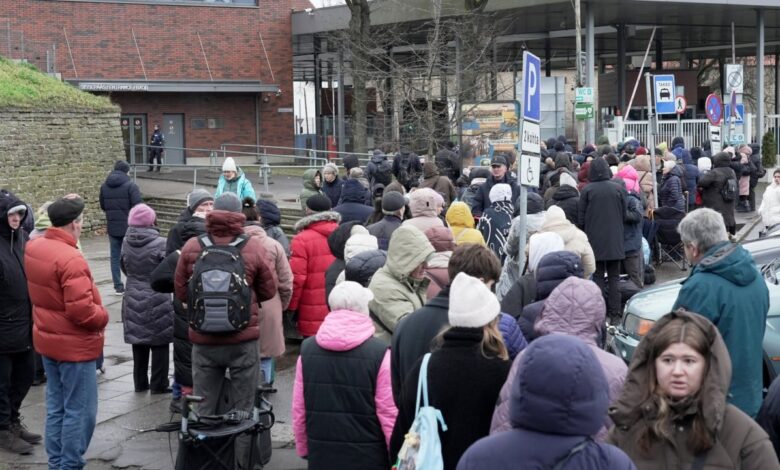
The decision to suspend cross-border traffic is framed by Tallinn not as a reaction to a singular event, but as the culmination of a pattern of hostile actions. On Sunday, Estonian Prosecutor General Astrid Asi confirmed that the intruders, who arrived shortly after 3 a.m., were attempting to set fire to the Threod Systems facility. Eight suspects, all residents of neighboring Latvia, were detained in connection with the incident, with five subsequently remanded in custody. Estonian Internal Security Service (KAPO) officials stated that intelligence gathered by their officers indicated the attack was commissioned by the GRU, Russia’s military intelligence agency. This allegation aligns with a broader narrative of hybrid warfare, a term used by Estonian Prime Minister Kristen Michal to describe Russia’s strategy of decreasing support for Ukraine and applying pressure on European nations.
The economic and strategic implications of the border closure are substantial, particularly given the role of the Baltic states as a frontline buffer zone in the ongoing conflict. The closure, which will remain in effect for at least six months before a review, directly impacts the flow of goods and people between the two countries. While specific trade volume data for the immediately preceding period was not detailed in the available reports, the suspension represents a tangible disruption to the land bridge that has historically facilitated commercial and private travel. For industries reliant on cross-border logistics, the six-month suspension introduces a period of uncertainty and operational adjustment. More broadly, the move signals a hardening of security postures that may affect regional supply chains and investment confidence in the Baltic region, as businesses and consumers adapt to stricter border controls and heightened security environments.
This incident is the second major sabotage attempt on an Estonian defense company this year. In August, officials reported an arson attack on Milrem Robotics, a supplier of unmanned ground vehicles to Ukraine. Estonian authorities formally attributed that incident to Russian intelligence in September. KAPO has warned that Russia is increasingly targeting European defense manufacturers with the explicit aim of disrupting military production and deliveries to Ukraine. By closing the border, the Estonian government is attempting to sever the physical pathways that could be exploited for further such incursions or espionage activities. Foreign Minister Margus Tsahkna stated on social media that “Russia must understand that hostile actions against Estonia come with consequences,” emphasizing that attempts to intimidate or destabilize the country would not go unanswered.
Moscow has rejected the accusations, maintaining a consistent line of denial regarding its involvement in such activities. Maria Zakharova, a spokeswoman for the Russian Foreign Ministry, accused Estonia of using the threat as a false pretext. “Such moves are tantamount to attempts to erect a new Iron Curtain under the false pretence of some sort of threat from the East,” Zakharova said during a press briefing in Moscow. She stated that Russia would take “necessary political and diplomatic measures” to safeguard its national interests if Tallinn proceeded with the closure. The Kremlin also denied the specific accusation regarding the Threod Systems attack, labeling it part of a “pattern of false allegations against Moscow emanating from European countries.” This diplomatic standoff highlights the deepening divergence in narratives between the West and Russia, where security concerns are interpreted by Moscow as geopolitical containment.
The closure of the border also intersects with broader regional security dynamics. The timing coincides with other developments in the Black Sea and Eastern Europe, including recent incidents involving commercial vessels near Romania’s coast and ongoing debates within NATO regarding the protection of critical infrastructure and supply lines. While these events are geographically distinct, they contribute to a cumulative effect of heightened tension that affects economic planning and risk assessment across the continent. For Estonian households and businesses, the immediate impact is a reduction in accessibility to the Russian market and a potential increase in security-related costs or administrative burdens. However, the primary driver remains the protection of critical defense infrastructure, which Estonian officials view as essential to national and regional security.
As the December 1 deadline approaches, the focus will shift to the implementation of the closure and the subsequent six-month review period. The outcome of the ongoing investigation into the Threod Systems attack, particularly the testimony of the detained suspects and any further intelligence disclosures, will likely influence whether the suspension is extended. For now, the border stands closed, a physical manifestation of the digital and hybrid front lines that have become increasingly defined in the post-Cold War order. The next step lies in the hands of Estonian policymakers, who must balance the imperative of security against the economic and diplomatic costs of isolation, while Moscow continues to frame the action as a hostile geopolitical maneuver rather than a defensive security measure.