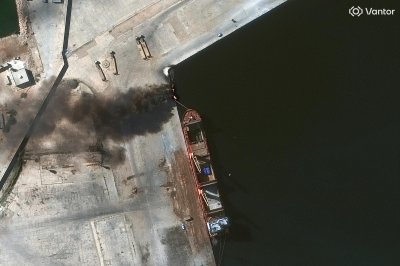
Satellite imagery analyzed by the Institute for the Study of War indicated that the Merkury had capsized, with only its bow remaining visible above water. The vessel had been stopped at Benghazi for several days under a cooperation agreement to refuel and resupply while escorting Russian cargo vessels. The incident occurred in a region controlled by military commander Khalifa Haftar, whose Libyan National Army maintains ties with Russia. Zelenskyy described the strike as an “exemplary operation” in response to Russian aggression, noting that the targets set were achieved.
The Kremlin’s response was swift and severe. Spokesman Dmitry Peskov described the incidents, including a separate drone attack on the Russian cargo ship Sparta II in the Gulf of Finland earlier that week, as a “very dangerous trend” of increasing terrorist activity. Peskov warned of “painful” consequences and urged regional nations to warn Kyiv against such operations. Russian authorities stated that two drones hit the Sparta II in international waters, causing it to catch fire and drift into Finnish waters, where all 16 crew members were evacuated with one minor injury. Kyiv has not publicly claimed responsibility for the Sparta II strike.
The attacks have raised significant diplomatic and sovereignty issues in divided Libya. The eastern-based administration, led by Prime Minister Osama Hamad, condemned the attack as a violation of sovereignty and requested that the United Nations investigate suspicions that the drones were launched from western Libya. Hamad also asked the UN to verify whether Ukrainian military experts are operating in the region. The internationally recognized Government of National Unity in Tripoli expressed concern over the risks of involving civilian ports in activities linked to external conflicts. Saddam Haftar, son of Khalifa Haftar, stated on Facebook that Libya’s security is a national responsibility that cannot tolerate the exploitation of incidents to promote accusations.
This operation marks a notable expansion of the war beyond the Black Sea theater, as Ukraine continues to target Russian naval assets and its so-called “shadow fleet.” The strikes coincide with the resumption of U.S.-backed peace talks between Moscow and Kyiv this month, which had been paused for nine months. While President Donald Trump has pushed for a ceasefire, Zelenskyy has maintained a steadfast position against ceding occupied territory, such as the land bridge in the Zaporizhzhia and Kherson regions, in exchange for security guarantees. The next expected development involves potential UN investigation findings regarding the launch sites of the drones and further official responses from Moscow and the Libyan governments.