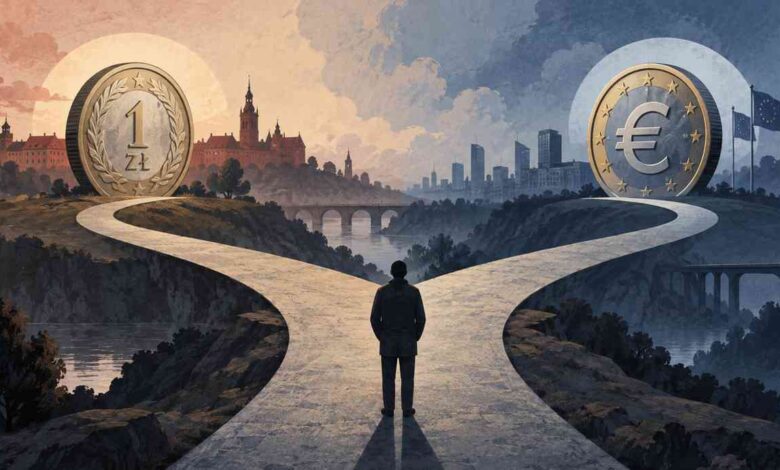
Finance Minister Andrzej Domanski recently articulated the current government’s position, asserting that Poland’s robust economic performance has effectively removed the urgency to join the eurozone. Speaking to the Financial Times, Domanski stated, “Our economy is now doing clearly better than most of those that have the euro.” He emphasized that the country is “better served by retaining the zloty for now,” citing faster growth rates and improving economic indicators as primary justifications for maintaining monetary autonomy.
This stance represents a significant departure from the policy of Prime Minister Donald Tusk’s first term in 2008, when his government actively backed euro adoption. That earlier push was shelved following the 2008 global financial crisis and the subsequent sovereign debt crisis in the eurozone. The conservative Law and Justice party, which governed Poland between 2015 and 2023, capitalized on this hesitation, framing the zloty not merely as a unit of account, but as a symbol of national sovereignty. With Tusk’s return to power in October 2023, one might have expected a reinvigorated push for integration. Instead, the administration has aligned itself more closely with the public sentiment that views the currency change as unnecessary, if not detrimental.
The economic argument against adoption is gaining traction in Poland, mirroring debates across the continent. Proponents of the euro traditionally point to the elimination of exchange-rate risk, reduced transaction costs, and enhanced macroeconomic credibility among investors. However, opponents argue that the ability to devalue one’s own currency serves as a crucial cushioning mechanism during crises. They point to the divergent post-2008 trajectories, noting that countries outside the eurozone, such as Poland, the United Kingdom, and Iceland, often coped with economic shocks more effectively than Mediterranean eurozone members, and in some metrics, even Germany.
Stefan Kawalec, a co-author of the Balcerowicz Plan and former deputy finance minister, has co-authored work arguing that the euro can be a trap, a view shared by several Nobel laureates in economics. Joseph Stiglitz has described the common currency as “flawed at birth,” while Paul Krugman has argued it delayed European integration. While the spectrum of economic opinion is vast, the political dimension remains dominant. In Poland, the debate closely tracks the division between those who declare a strong attachment to national sovereignty and those who prioritize European integration. The choice between monetary sovereignty and surrendering it is, as one analysis notes, purely political.
Public opinion in Poland remains firmly against the switch. A recent survey indicates that more than 62% of Poles are against adopting the euro, with a significant 44% strongly opposing the change. This widespread skepticism suggests that any government move toward adoption would face substantial domestic resistance. The zloty’s recent strengthening against the euro further solidifies the argument that the currency has its own distinct value and stability, independent of the single currency.
The path to adoption remains long and uncertain. While Denmark secured a treaty-based exemption following its 1992 referendum and the Edinburgh Agreement, and Sweden has delayed compliance for years, Poland has not yet sought a formal opt-out. Instead, it is exercising the flexibility of the timeline, using its economic outperformance as leverage to postpone the decision indefinitely. The next major test will not be a referendum, but the continued divergence between Poland’s growth metrics and the sluggish performance of much of the eurozone, a dynamic that currently favors the status quo.