The decline stands in sharp contrast to the session the previous day. On Wednesday, the STI had already recorded a 1.6% loss, ending at 5,608.44 after trading in a range between 5,603.70 and 5,679.15. This followed a weaker end to September, where the index closed at 5,675.88, down 1.4% for the month. The consecutive drops highlight a broader regional retreat, with Asian markets tracking the overnight weakness seen on Wall Street. At Wednesday’s close, the US S&P 500 and Nasdaq each fell 0.22%, while the Dow Jones Industrial Average declined 0.66%.
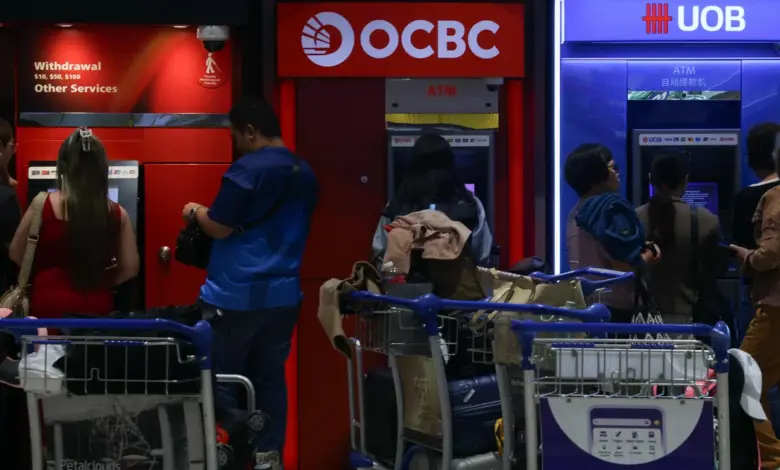
Banking stocks formed the epicenter of Thursday’s sell-off, leading the STI’s descent. The three major lenders, DBS, OCBC, and UOB, all posted substantial losses that erased billions of dollars in market capitalization. As of 10:45 am, DBS shares had dropped 3.4%, or S$2.62, to trade at S$74.87. UOB experienced a sharper 4.7% slide, losing S$1.98 to close at S$40.46, while OCBC fell 4.4%, or S$1.32, to S$28.98.
“When expectations are already elevated, it can take slightly negative news to trigger some profit-taking,” said James Ooi, market strategist at Tiger Brokers.
The market’s reaction was driven by two primary macroeconomic factors: the trajectory of Treasury yields and the price of oil. Elevated crude oil prices have kept inflation concerns in the foreground, prompting Treasury yields to move higher earlier in the session. Investors remained sensitive to heavy long-end supply and broader weakness across global bond markets. Ooi noted that this environment had made the market more sensitive to earnings risks and negative catalysts, particularly after a recent strong rally in bank shares.

A key area of reassessment involves the relationship between interest rates and bank profitability. While higher Singapore dollar interest rates are traditionally viewed positively for banks, the market is increasingly focusing on the cost of funds. Higher rates lift yields on loans and newly deployed assets, but they simultaneously increase what banks pay for deposits and other funding sources. The critical metric for investors has shifted from the direction of rates alone to whether asset yields can keep pace with rising funding costs to defend net interest margins. The upcoming earnings season, expected in about a month, is anticipated to provide clearer evidence on whether these macroeconomic headwinds are materializing in the banks’ financial results.
The weakness in Singapore was mirrored across the region. At the same time as the STI slid, the Kuala Lumpur Composite Index (KLCI) was down 0.6%, and Hong Kong’s Hang Seng Index retreated 0.2%. Japanese markets saw more pronounced declines, with the Nikkei 225 falling 1% and the broader TOPIX index losing 1.5%. South Korea’s Kospi index was 0.8% weaker. This broad-based regional dip underscores the interconnectedness of Asian equity markets with global bond yields and commodity prices.
Despite the equity market turbulence, Singapore’s macroeconomic fundamentals remained steady. Data published by the Monetary Authority of Singapore on Wednesday indicated that the country’s total foreign reserves increased to S$553.6 billion as of the end of September, up from S$550.7 billion at the end of August. This provides a buffer of stability amidst the equity volatility.

On the corporate front, select stocks defied the broader market trend. Shares of Mary Chia surged nearly 108% at Wednesday’s close after the company signed subscription agreements with four subscribers for 100 million shares at S$0.01 per share. Similarly, Autagco closed over 25% higher following the signing of a non-binding memorandum of understanding with Stanley Li and Karen Loh to acquire the entire share capital of Malaysia-based Yess Ventures Enterprise.
Investors will now look ahead to the upcoming earnings season for a definitive assessment of how the current interest rate environment is affecting the profitability of Singapore’s banking sector. Until then, the market remains exposed to further volatility driven by global bond supply and oil price movements.