At the close of trading on Friday, SJC gold was bought at 141.8 million dong and sold at 144.8 million dong per tael. On the morning of October 12, this price structure remained unchanged across major dealers, including DOJI, Phu Quy, and PNJ. While the selling price is uniform among top-tier brands like SJC, DOJI, and Phu Quy, buying prices show slight variations. For instance, Bao Tin Minh Chau quoted a lower buying price of 139.8 million dong for gold bars, a 2 million dong discount compared to SJC, reflecting differing inventory management and risk appetites among dealers. The buy-sell spread for SJC gold bars remained at 3 million dong per tael, a standard margin that protects dealers against rapid price fluctuations.
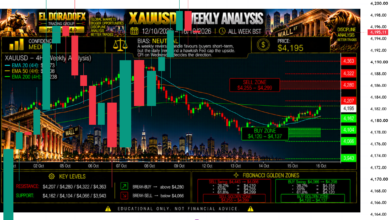
The domestic market’s stability mirrors developments in international precious metals markets, where spot gold has been testing the psychological resistance level of $4,200 per ounce. As of early morning on October 12, global spot gold prices were quoted around $4,194 to $4,196 per ounce. This level represents a recovery from the recent low of $4,069.1 per ounce touched on October 8, when international prices plunged more than 2% ahead of the release of the Federal Reserve’s September meeting minutes. The subsequent rebound was driven by technical factors, with the December gold futures contract entering oversold territory, suggesting potential for short-term price recovery.
However, the recovery remains cautious. Analysts note that the precious metal has yet to decisively break above the $4,200 mark, a level that has acted as a significant ceiling. The primary headwinds include a strengthening U.S. dollar, with the USD index holding around 102.20 points, and persistently high U.S. Treasury yields. The 10-year U.S. Treasury yield recently spiked to 5.36%, creating sharp volatility in the gold market. High interest rates typically reduce the appeal of gold, an asset that generates no fixed income, thereby limiting upward momentum even as other supportive factors remain in play.
Despite yield pressures, structural demand continues to underpin the market. The People’s Bank of China extended its consecutive buying streak to 23 months, purchasing an additional 740,000 ounces of gold in September. This was the largest monthly purchase since 2023, raising total Chinese gold reserves to 2,408 tonnes. This sustained central bank accumulation is viewed as a key pillar preventing deeper declines in international prices during periods of rising yields and dollar strength. Market participants are now focused on upcoming U.S. inflation data, specifically the Consumer Price Index (CPI) and Producer Price Index (PPI), which will be released next week. These figures are critical for assessing the Federal Reserve’s policy trajectory, as markets currently price in a high probability of a rate decision that will influence both the dollar’s strength and the future direction of gold prices. Until these economic signals clarify, gold is expected to fluctuate within a wide range, with 2026 potentially marking one of the most volatile periods for the metal since 1982.