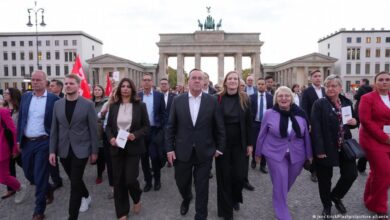

During the legislature’s first sitting on Tuesday, the newly elected assembly elected Tobias Rausch, an AfD member, as its speaker. The role, traditionally reserved for the largest party, was viewed as an initial symbolic victory for the far-right group. The state’s next governor is not expected to be chosen before December, leaving a period of political uncertainty as the AfD seeks to negotiate with other parties. Ulrich Siegmund, the party’s charismatic state leader, called on other political groups to cooperate, stating, “As a democrat, I will reach out to all those who wish to work with us to bring about a fundamental political turnaround.” However, forming a government remains difficult, as mainstream parties remain wary of allying with a group classified as “far-right extremist” by Germany’s domestic intelligence agency.
The election result has triggered an immediate sense of displacement among migrants in the region. In Magdeburg, Ola Akhras, a Syrian doctor who fled Homs in 2018, said she and her husband are now discussing whether to return to Syria. Akhras noted that while she feels appreciated in her professional environment, she has encountered hostility in public spaces and no longer feels safe leaving home in the evening. “Our children will never be recognized as Germans here,” she said. Undra Dressler, executive director of the Saxony-Anhalt State Network of Migrant Organizations, reported that counseling centers are overwhelmed, with appointments fully booked as individuals report racist incidents and consider leaving the country. While no official figures yet confirm a spike in racist incidents, the psychological impact on the community is widely reported.
The AfD’s surge in Saxony-Anhalt reflects a broader shift in German politics, particularly in the economically weaker eastern states. The party has capitalized on public dissatisfaction with the federal government’s handling of slow economic growth, high inflation, and rising energy prices. Critics of immigration have increasingly blamed newcomers for these economic challenges, a narrative that has resonated in regions like Saxony-Anhalt. The party’s platform includes strong restrictions on immigration, the restoration of ties with Russia, a reduction in support for Ukraine, and a potential exit from the eurozone.
Political opposition to the AfD’s rise has mobilized across Germany. Thousands of demonstrators gathered in Berlin, with organizers claiming over 14,000 attendees at a rally near the Brandenburg Gate, while police reported 5,000. Protests were also held in cities including Potsdam, Dresden, and Aachen. Jens-Christian Wagner, director of the Buchenwald memorial, described the election result as a “disgrace” and warned that the far-right’s potential takeover of state power “should not be accepted in silence.” The momentum from Saxony-Anhalt is expected to influence upcoming regional elections in Berlin and Mecklenburg-Western Pomerania, both scheduled for September 20.
The state election underscored the party’s growing influence at the national level. Recent polling indicates the AfD is currently Germany’s most popular party, with support levels reaching up to 28 percent, placing it ahead of Chancellor Friedrich Merz’s Christian Democratic Union (CDU). Forecasts suggest the AfD could finish first in the 2029 national election. The party’s strength is particularly pronounced in eastern Germany, where dissatisfaction with the current federal coalition exceeds 90 percent, compared to 87 percent in the west. This trend was further highlighted by the recent mayoral election in Zehdenick, Brandenburg, where AfD candidate René Stadtkewitz won 58.4 percent of the vote, becoming the first directly elected AfD mayor in the state.
Mainstream parties have so far been unable to halt the AfD’s ascent despite the intelligence agency’s designation. The next critical step in the political process will be the formation of a state government in Saxony-Anhalt, a development that will serve as a test case for whether the far-right can translate electoral success into executive power in a post-war German state.