
The resignation follows the release of 40 declassified documents on Wednesday, which detail communications between Spain’s National Intelligence Center (CNI), local authorities, and Moroccan intelligence services leading up to the mass entry of migrants into the Spanish enclave. The documents appear to contradict the public narrative maintained by Prime Minister Pedro Sánchez regarding the government’s prior knowledge of the event’s scale.
According to the released files, on July 29—one day before more than 72,000 people began crossing the border from Morocco—the CNI sent an alert via WhatsApp to the Spanish government’s delegation in Ceuta. The message referenced social media calls “for an assault on the fence and by sea” scheduled for 8 p.m. the following day. The intelligence message noted that two specific social media groups, with a combined total of 180,000 followers, were coordinating the effort, providing “an idea of its scale.” On the same day, the CNI also warned Moroccan intelligence agencies, including the DGST and DGED, that migrants might exploit Morocco’s national Throne Day celebrations on July 30 to climb the border fence or swim around it.
Despite these warnings, Prime Minister Sánchez rejected the interpretation that the documents revealed a clear prediction of the crisis’s magnitude. “The existence of this campaign was known to other institutions and was being monitored, but in no way did it constitute or could it be interpreted as an indicator of the scale, nature, or probability of what happened afterward,” Sánchez wrote on social media. He has consistently defended his government’s response and stated there is no evidence that the Moroccan government orchestrated the incident, a stance that has drawn sharp criticism from opposition parties who accuse the administration of negligence.

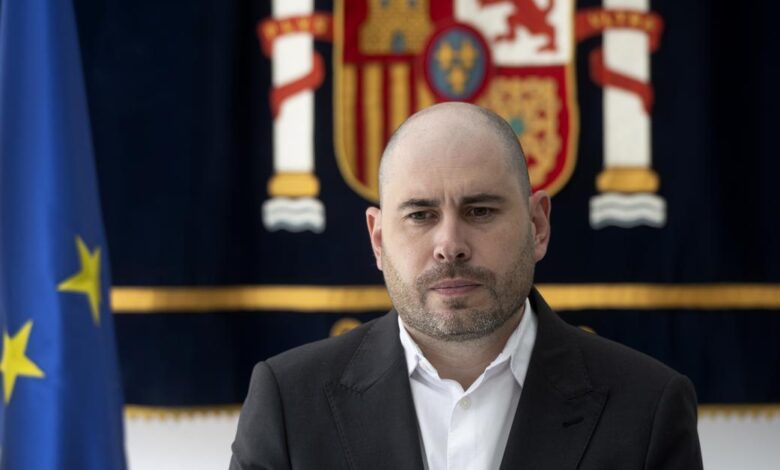
The political fallout has been swift and severe. Days before the delegate’s resignation, his chief of staff, Gonzalo Sanz, stepped down. Sanz stated that he had forwarded the CNI’s warnings to Pérez Triano, a claim the delegate denied, asserting he had no prior knowledge of the intelligence. This internal dispute has further complicated the government’s position as it attempts to manage the aftermath of the influx.
The crisis has triggered widespread public unrest. Tens of thousands of people marched in Madrid on Saturday to protest the government’s handling of irregular migration. Organizers from the civil society platform Sociedad Civil Española claimed 180,000 participants joined the rally, which was supported by the conservative People’s Party (PP) and the far-right Vox party. In contrast, Madrid’s government delegation estimated the turnout at approximately 20,000. Demonstrators called for early elections, a demand that contrasts with the constitutional timeline, as Spain’s next general election is not due until 2027.
Political leaders have used the crisis to intensify their rhetoric. PP Secretary-General Miguel Tellado accused the government of negligence, while Vox leader Santiago Abascal called for the deportation of migrants who entered during the July influx. The protests have also fueled a broader diplomatic tension, with opposition parties launching campaigns targeting Morocco over its role in the events. A leaked police report alleged the involvement of Moroccan police, though a Defense Ministry intelligence report from July 30 stated that Moroccan forces were “passive and acted negligently” to stop the migrants, adding that Morocco might attempt to “exploit the situation” for strategic interests. The Moroccan foreign ministry has not responded to requests for comment regarding the declassified documents.

While the political debate rages in Madrid, the human cost remains concentrated in Ceuta. The small autonomous city is grappling with a prolonged humanitarian burden. National government figures indicate that approximately 5,000 migrants remain in the enclave weeks after the initial rush, though local officials cite a higher number, up to 10,000. The city’s infrastructure is strained, and the replacement of the government delegate, reportedly David de la Encina, a former mayor of El Puerto de Santa María, will be tasked with navigating this complex administrative and social landscape.
As the new delegate takes office, the focus shifts to how the central government will address the infrastructure gaps and the integration of the remaining migrants. The declassified files have set a high bar for accountability, and any further discrepancies between official statements and intelligence records may further erode public trust in the government’s crisis management capabilities.