
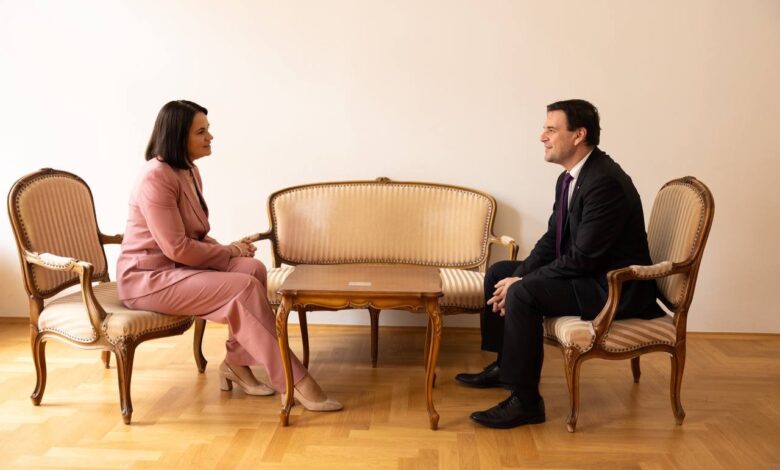
During the meeting, Tsikhanouskaya expressed gratitude for the Czech Republic’s consistent support for Belarusians on the international stage. She highlighted a tangible outcome of their discussions: a decision to simplify visa procedures and issue visas to relatives of Belarusians residing in the Czech Republic. “This will help many people facing serious difficulties,” Tsikhanouskaya stated, noting that she was grateful for the trust placed in her office in Prague. Macinka confirmed that the official decision regarding these visa simplifications is expected to be published in the near future. For the roughly 100,000 Belarusians who have fled the country since 2020, such administrative adjustments represent a critical lifeline, easing the bureaucratic hurdles that have complicated family reunification and social integration in their host nations.
While this engagement focused on humanitarian and democratic solidarity, Macinka’s diplomatic schedule simultaneously addressed hard security concerns. In a separate development, the Czech Foreign Minister held phone talks with Andrii Sybiha, the Deputy Prime Minister and Minister of Foreign Affairs of Ukraine, indicating ongoing coordination on matters of mutual security interest. However, the most significant strategic revelation came from Macinka’s interactions with Israel. During a press conference with Israeli Foreign Minister Gideon Sa’ar, Macinka disclosed that Czechia is in active talks with Israeli firms to purchase a number of air-defense systems.
Specifically, Macinka confirmed that Prague is discussing the acquisition of the Spyder and Arrow systems, among others. “We’re discussing air-defense systems with Israel because these systems are technologically on top,” Macinka said. This procurement interest reflects a broader European trend of seeking advanced air defense capabilities to counter evolving threats in the region. The Czech government’s interest in these specific Israeli systems underscores a recognition of Israeli innovation in the fields of defense and security, particularly as European nations reassess their own defensive postures.
The diplomatic exchange with Israel also carried significant political weight regarding Czechia’s position within the European Union. Foreign Minister Sa’ar expressed gratitude for Czechia’s friendship and “allyship,” explicitly thanking Prague for “not allowing the European Union to be turned into a tool for promoting anti-Israeli policies.” Sa’ar emphasized that “Israel is becoming an increasingly significant country in the defense of Europe itself, and Europe benefits from its activities in the field of security.” This statement highlights the strategic alignment between Prague and Jerusalem, positioning the Czech Republic as a key bridge between Israeli security capabilities and European defense needs.
These concurrent diplomatic moves illustrate a multifaceted foreign policy approach. On one hand, Prague maintains a principled and high-visibility support for the Belarusian opposition, using symbolic gestures and practical visa reforms to sustain the diaspora and pressure the Lukashenka regime. On the other hand, it is actively deepening strategic and economic cooperation with Israel, focusing on high-tech defense acquisitions that enhance its own security and contribute to broader European defense resilience. The visa decision for relatives of Belarusians remains a pending but imminent administrative change, set to impact thousands of individuals. Meanwhile, the defense talks with Israel continue to advance, with the Czech government vowing to strengthen political and economic ties, ensuring that security cooperation remains a cornerstone of its bilateral relationship with one of Europe’s most significant defense partners.