The statement marked a definitive break from the diplomatic trajectory set by the United States. The 15-point plan, outlined by President Donald Trump last month and touted as a breakthrough in his administration’s foreign policy agenda, called for a phased withdrawal of Israeli troops from Gaza alongside the disarmament of Hamas. Trump had recently claimed that Hamas had agreed to lay down its arms, presenting the framework as a viable path to stability. However, Netanyahu’s rejection hinges on a single, non-negotiable condition: the complete and prior disarmament of Hamas before any Israeli withdrawal occurs.
“The IDF will not carry out any withdrawal until Hamas is disarmed,” Netanyahu said. He emphasized the scope of this requirement, specifying that “genuine disarmament” involves the surrender of heavy weapons, lighter weapons, and all other armaments. “When I say Hamas must be disarmed, we are talking about genuine disarmament, not a fictitious one,” he added.
This divergence in sequencing—disarmament first for Israel, withdrawal first for Hamas—highlights the fundamental impasse in the peace process. Last month, Hamas stated it would disarm but only after Israel withdraws completely and ceases all hostilities. The group further specified that the laying down of heavy weapons would occur later in the process, conditional on the establishment of a Palestinian state. Netanyahu, however, reaffirmed his long-standing position against such a state, declaring, “As long as I am prime minister, there will be no Palestinian state.”
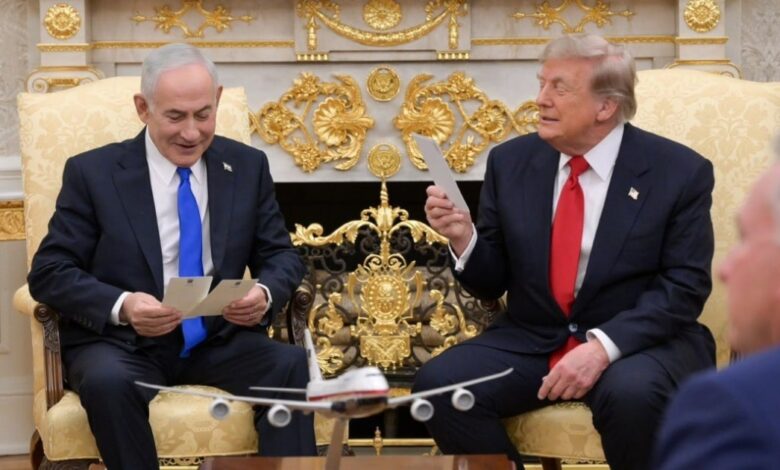
The diplomatic friction extends beyond the specific mechanics of the peace plan. The explicit rejection comes after months of growing tensions between the White House and Israel’s leadership, particularly regarding the war in Iran. While the White House did not immediately comment on Netanyahu’s remarks, the Israeli leader addressed the bilateral relationship directly: “We are currently discussing this issue with the Americans. They have ideas; some of them are acceptable to us and some are not, and we know how to stand firm on these matters.”
Analysts suggest that domestic political pressures are influencing Netanyahu’s stance. Facing a critical election in October, the Prime Minister is in a battle for political survival, with the status of the Gaza and Iran wars expected to be pivotal factors. Ronni Shaked, a research fellow at the Harry S. Truman Institute at the Hebrew University of Jerusalem, noted that Netanyahu may find it strategically advantageous to “enter a new confrontation with President Trump.” Shaked described the Prime Minister’s approach as an “illusion” of victory, arguing that after three years without a definitive strategic win, Netanyahu seeks to demonstrate to the Israeli public that he is demanding the total disarmament of Hamas prior to the election.

Reactions to the rejection were swift and varied across the region. Basim Naeem, a senior Hamas official, responded by stating that the group expects mediators and the United States to “exert pressure” on Netanyahu and his government. Naeem accused the Prime Minister of obstructing the process for “domestic political and electoral considerations.” A subsequent statement from Hamas reaffirmed its commitment to the agreed-upon roadmap, emphasizing its “seriousness in engaging responsibly” and calling for a clear timetable for implementation.
In the Palestinian Legislative Council, Mohammad Dahlan characterized the announcement as a “challenge, contempt, and deception” of the American administration. He added that Washington now realizes that Netanyahu is an obstacle to achieving security and stability. Conversely, Bezalel Smotrich, Israel’s far-right finance minister, welcomed the decision. Smotrich, who had previously sought to pressure the Prime Minister into a harder line, posted on X: “I congratulate the Prime Minister for responding to our demand and clarifying unequivocally.”
Egypt, a key mediator, called for restraint. Foreign Minister Badr Abdelatty emphasized the necessity for all parties to fulfill their commitments and refrain from actions that could hinder the implementation process or undermine progress achieved. This diplomatic intervention occurs against a backdrop of continued violence despite a ceasefire agreement reached in October. Israel and Hamas regularly accuse one another of breaching the truce. On Saturday, recovery operations concluded at the Karam Building in Gaza, where 19 bodies were found under the rubble, according to Gaza civil defense. Health officials in the enclave report that more than 73,000 people have been killed since October 7, 2023, with more than 1,200 deaths occurring since the ceasefire began in October.
The original war was launched by Israel in response to the Hamas-led attack on October 7, 2023, in which approximately 1,200 people were killed and 251 taken hostage. As the political stakes rise ahead of the October election, the rejection of the 15-point plan leaves the central question of Gaza’s future unresolved. The disconnect between the US-led framework and Israel’s domestic political reality suggests that the path to a durable ceasefire remains fraught with uncertainty, with both sides digging in on their respective prerequisites.