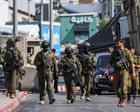
In response to the attack, Israeli Prime Minister Benjamin Netanyahu ordered the army to prepare for a “very extensive” operation in the occupied West Bank. Describing the scale as unseen in decades, Netanyahu stated that the military would conduct house-to-house searches and demolish homes in the neighborhood of the attackers. The prime minister’s office announced that security forces had been instructed to immediately cordon off Hebron and prepare for a full closure of the West Bank starting on Friday.
This decision marks a significant escalation in the Israeli military’s approach to the West Bank, particularly in the context of the national elections scheduled for Tuesday, just days after the incident. Netanyahu, who held an emergency meeting of his security cabinet and top military officials following the shooting, claimed that Hamas was “planning a major attack aimed at murdering innocent civilians.” He indicated that the military would apply a model previously used in refugee camps in the northern West Bank, specifically referencing the “Iron Wall” operation launched in January 2025. According to the UN rights office, that previous operation forcibly displaced tens of thousands of people across several camps. Netanyahu declared his intention to evacuate residents, seize weapons, and destroy what he described as “terrorist infrastructure.”
The economic and social implications of such closures are increasingly tangible for residents of the West Bank. Friday’s lockdown was the fourth time in the past month that Israel imposed restrictions across the territory. These closures involve shutting gates and checkpoints that connect Palestinian villages to major roads. While these routes are closed to Palestinians, they remain open to Israeli drivers, including settlers, who can continue to travel through the area. This differential access creates a fragmented trading and movement environment, isolating Palestinian communities while maintaining connectivity for Israeli forces and settlers.
The political stakes of this escalation are high. The vote comes three years after the Hamas-led attacks on Israel that triggered the war in Gaza. Far-right Finance Minister Bezalel Smotrich, who also holds a position within the defence ministry, called for a military campaign in the West Bank “exactly like in Gaza.” Smotrich argued that there is “no other option but a comprehensive military campaign to dismantle the Palestinian Authority, collect weapons and eliminate terrorists,” comparing the proposed actions to those in Gaza and Lebanon. He added that in the next government, such measures would be among the first applied.
Human rights groups have warned that the government may use the attack on soldiers to justify tougher measures against Palestinians, bolstering security credentials ahead of the election. Yariv Oppenheimer, the former director of Peace Now, told Al Jazeera that “every day in the West Bank is a dramatic day for the Palestinians.” He noted that the Israeli army is increasingly entering Palestinian cities, and settlers are attacking Palestinians, creating an “impossible” situation. Oppenheimer predicted that the operation would lead to house demolitions, curfews, increased arrests, and potential retaliatory violence by settlers targeting Palestinians.
The broader context of the West Bank is defined by accelerating land seizures and settlement expansion. Since the war in Gaza began in October 2023, the campaign against Palestinians has intensified. Authorities have stepped up demolitions of homes lacking building permits, displacing families from their land. More than 1,100 Palestinians have been killed in the West Bank by Israeli forces or settlers during this period. Violence has surged during the annual olive harvest, a critical economic activity for many Palestinian families. In mid-October, settlers attacked Palestinian villages, burning cars and trees, and injuring a Washington Post photographer. The following day, they attacked European diplomats, a French mayor, and Palestinian olive pickers, injuring three people and damaging a diplomatic vehicle.
As the Israeli army prepares to enter the neighborhood of the Hebron attackers, the focus shifts to the immediate impact on local infrastructure and daily life. The closure of checkpoints and the threat of house demolitions directly affect the ability of residents to access work, markets, and services. The “Iron Wall” model, previously applied in the northern West Bank, demonstrates the scale of displacement that can result from such operations. With tens of thousands previously displaced in that campaign, the current operation promises similar or greater disruption to the social and economic fabric of Hebron and the wider West Bank. The outcome of Tuesday’s election will likely determine whether this aggressive security posture is sustained or modified, but for now, the immediate order is clear: full closure, house-to-house searches, and the enforcement of a military model designed to eliminate perceived security threats at the cost of significant civilian displacement.