The protests, led by trade unions and student groups, represent a fresh challenge to President Emmanuel Macron’s government in the final months of his presidency, ahead of the May 2027 election. The central grievances remain consistent: soaring living costs, wage stagnation, and insufficient funding for public services, particularly schools. Murielle Guilbert, co-leader of the left-wing Solidaires union federation, described the situation as an “aggregation of anger” uniting students, workers, and firefighters. The movement’s persistence is evident in the call for fresh demonstrations on October 31 and a nationwide strike on November 5, aimed at maintaining pressure on a government that protest leaders deem inadequate in its proposals.
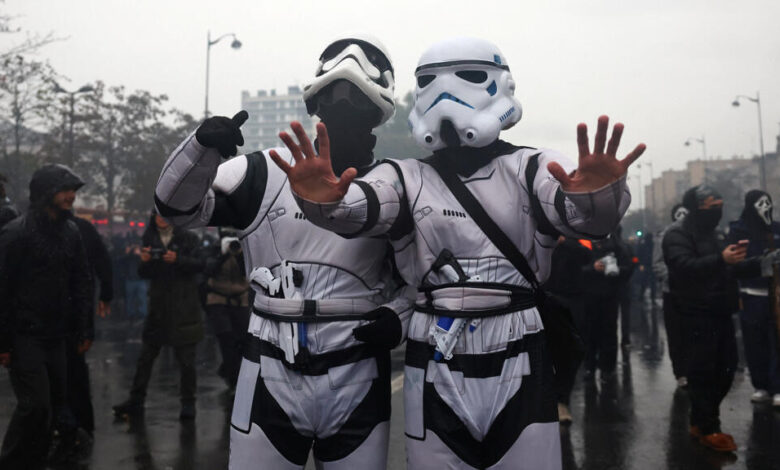
The scale of the mobilization is a subject of ongoing debate, reflecting the broader tension between official narratives and union claims. The Interior Ministry estimated nationwide turnout at 410,000, including 110,000 in Paris. In contrast, the CGT union, one of France’s largest labor federations, estimated the number of participants to be nearly 800,000. Regardless of the precise figures, the scale was undeniable. In Paris, an Associated Press journalist observed tens of thousands marching from Porte d’Italie, noting the crowd appeared smaller than the previous weekend but still substantial. Trade unions led the procession, followed by protesters in raincoats carrying flags and handmade placards.
Security forces were deployed in unprecedented numbers, with 70,000 officers backed by helicopters and armored vehicles. Interior Minister Laurent Nuñez stated that this “beefed-up policing” helped prevent a repeat of the widespread looting and damage to shops that occurred during the previous weekend. On Saturday, police made nearly 1,000 arrests, a number Nuñez noted is expected to rise as counts are finalized. The provisional Interior Ministry tally stood at 1,314 detentions. While 53 security personnel were injured and 24 businesses were looted, the ministry highlighted that “multiple lootings have been averted,” particularly in Paris where riots had caused significant damage to storefronts just days earlier.
Violence was not confined to the capital. Clashes erupted in cities including Marseille, Lyon, Bordeaux, Toulouse, and Tours. In Marseille, officers fired tear gas during confrontations with several dozen people near the march’s end point, where youths had blocked roads by setting trash cans on fire and throwing rocks at security forces. In Lyon, Clermont-Ferrand, and Strasbourg, police also used tear gas, while water cannons were deployed in Nice and Nantes. The ministry attributed the confrontations to groups including radical far-left activists, though it did not provide a specific figure for injured protesters. The previous weekend saw far greater destruction, with reports of 2,628 detentions and 1,144 injured security personnel, as well as the looting of approximately 1,500 shops.
The economic and social impact of the unrest has rippled through the city. In the wake of the previous week’s violence, shopkeepers in Paris have been forced to board up storefronts. Akram Ahmed, a 34-year-old contractor, described boarding up an optician’s shop near Saint-Lazare station, saying the owner “seemed desperate” and felt he was “saving his life.” Major cultural institutions, including the Louvre, Musée d’Orsay, and the Grand Palais, remained shuttered. The threat of unrest also forced Art Basel, a prestigious contemporary art fair, to cancel its weekend program, allowing public access only on Friday. Paris police prefect Patrice Faure initially urged shopkeepers to hire security guards, a statement he later clarified by reiterating that protecting businesses is the responsibility of the government.
The political stakes are high as the far-right National Rally has accused Macron’s government of failing to protect the public, urging citizens to channel their anger into votes. This political pressure coincides with a shift in protest logistics; authorities confined the Paris march to the city’s southeastern edge, away from the center. Soumaya Abed, a 58-year-old nurse and CGT member with 30 years of protest experience, criticized this move, stating, “They are using what happened last week as an excuse to quiet protesters. But it won’t stop the movement.” Her sentiment reflects a broader determination among participants to continue demanding better conditions, despite the significant security presence and the recent escalation of violence. As the government opens talks with unions and student representatives, the coming weeks will test whether diplomatic engagement can defuse the “utter chaos” that has gripped the country or if the cycle of strikes and unrest will deepen further.