
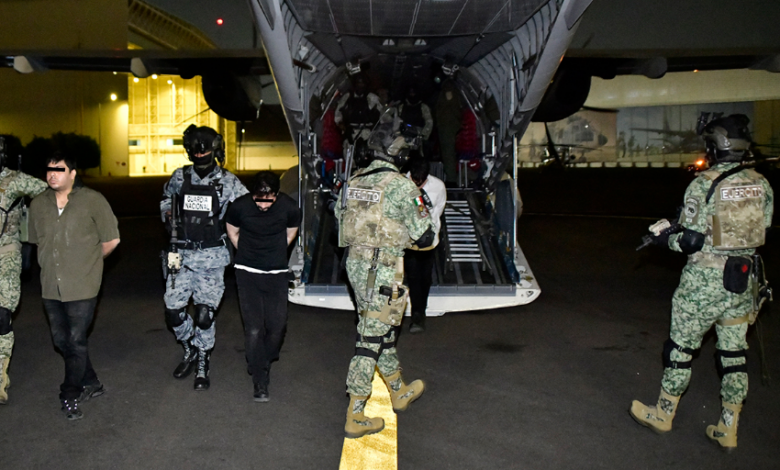
The central legal development is not merely the detention of a high-profile fugitive, but the verified use of U.S. surveillance technology within Mexican sovereign airspace. Mexican Defense Secretary Gen. Ricardo Trevilla Trejo stated that the capture was the result of “very important intelligence sharing” with U.S. authorities over the preceding three months, which pinpointed Meza Flores’ location. Specifically, officials confirmed that in the week leading up to the capture, Mexico authorized the United States to fly intelligence drones over Mexican territory to assist in tracking the criminal leader. While this cooperation facilitated the operation, President Claudia Sheinbaum emphasized on Monday that U.S. forces were not allowed to operate on the ground. She stated, “This case in particular demonstrates the capacity of the armed forces of Mexico to make major detentions,” reinforcing the government’s position that the operation was executed by Mexican personnel in compliance with domestic law.
The principal legal question surrounding the operation involves the jurisdictional boundaries of intelligence cooperation versus direct military intervention. The U.S. Justice Department had previously designated Meza Flores as a senior leader of the Sinaloa cartel, describing it as “one of the most prolific and dangerous drug cartels in Mexico, known for its widespread use of corruption and violence to further its drug trafficking activities.” The FBI had placed Meza Flores on its list of 10 most wanted fugitives, and the U.S. State Department offered a reward of up to $5 million for information leading to his arrest. However, the legal proceedings currently underway in Mexico are domestic in nature, focusing on charges of illegal possession of firearms rather than transnational drug trafficking, which is often the basis for U.S. extradition requests. This distinction underscores Mexico’s insistence on handling the judicial process within its own legal framework.

The capture triggered immediate public consequences in Sinaloa, characterized by a burst of violence that left 20 people dead in Guasave. Mexican officials reported that among the deceased were four soldiers and 16 suspected criminals. In response to the unrest, Mexican Security Secretary Omar García Harfuch announced that armed forces would remain deployed in the state to protect civilians. The retaliatory violence also led to the detention of eight alleged drug cartel members who were involved in the clashes. The operational details provided by the defense secretariat indicated that seven suspects were killed during the initial raid, while four members of the Mexican army were killed while traveling to reinforce security in the area. Bodycam footage released by authorities showed armed personnel entering a house via a garage to detain Meza Flores, providing visual evidence of the tactical execution of the warrant.
While the primary focus remains on Meza Flores, the broader context of U.S.-Mexico law enforcement cooperation includes other high-profile targets. The U.S. Department of State has designated La Nueva Familia Michoacana (LNFM) as a Foreign Terrorist Organization (FTO), a move that intensifies the legal pressure on its leadership. Among those targeted are Johnny and José Alfredo Hurtado Olascoaga, brothers accused of leading the cartel’s business operations. The DEA estimates that LNFM is responsible for the transportation and distribution of significant quantities of methamphetamine, heroin, and cocaine into the United States. The U.S. Department of Justice indicted the brothers in September 2024 on charges including conspiracy to manufacture and distribute controlled substances, importation conspiracy, and drug distribution conspiracy. Rewards of up to $5 million and $3 million have been offered for information leading to their apprehension, respectively.
The legal significance of the Meza Flores case extends beyond the individual charges. It illustrates a nuanced approach to bilateral security where intelligence tools, such as drones, are shared across borders, but operational control and judicial authority remain with the host nation. The U.S. has sought to line up allies across Latin America to allow U.S. forces to operate in their territories, receiving mixed responses from the region. In Mexico, however, the line has been drawn at ground operations. President Sheinbaum’s insistence on sovereignty, coupled with the Mexican military’s assertion of its own capacity, suggests a model of cooperation that prioritizes intelligence sharing over direct foreign military intervention.

What remains disputed or unresolved is the long-term sustainability of this drone-sharing arrangement and whether it will be formalized into a broader legal framework. While the current charges against Meza Flores focus on firearm possession, the U.S. continues to view him as a leader of a transnational criminal organization. The next confirmed legal step will be the continuation of the domestic trial in Mexico, where the evidence gathered through the joint intelligence operation will be scrutinized under Mexican procedural law. The case serves as a test of whether such cross-border intelligence cooperation can yield definitive judicial outcomes without compromising the national sovereignty of the host country.
The detention of Fausto Isidro Meza Flores marks a significant moment in the ongoing struggle against organized crime in Sinaloa. As Mexican courts proceed with the trial, the focus will remain on the evidence presented by the prosecution, which includes the intelligence data provided by U.S. allies. The outcome of this case will likely influence future security agreements between the two nations, balancing the need for effective law enforcement with the legal principles of national jurisdiction.