In most U.S. states, a margin this thin would automatically trigger a recount or allow candidates to petition for one. However, the Mississippi Secretary of State’s office confirmed to ABC News that the state has no formal recount process. Under Mississippi law, candidates cannot request a recount, nor is one automatically triggered by a narrow margin. Instead, the legal procedure available is a “ballot box exam,” which allows a candidate to examine ballot materials only after the election has been certified. If discrepancies or issues are found during this examination, the candidate may then file a legal challenge in court. This procedural distinction shifts the burden of proof and the timing of the dispute from an immediate administrative recount to a post-certification legal process.
The uncertainty is compounded by the volume of outstanding ballots. Mississippi law permits mail ballots to arrive up to five business days after the election, a deadline set for November 10, 2026, provided the ballots were postmarked on or before Election Day. Additionally, the state utilizes “affidavit ballots,” which are provisional ballots cast by residents whose addresses cannot be located in the precinct poll book. Mississippi Secretary of State Michael Watson stated in a Wednesday afternoon update that approximately 3,600 outstanding mail ballots could still be received within the next five business days. He also noted that an “unknown number” of affidavit ballots will be processed within the 10-day window counties have to certify their results, with the final certification deadline set for November 13.

Estimates of the remaining vote count vary significantly between the campaigns and state officials. Colom’s campaign manager stated on Tuesday night that the campaign believes there could be around 15,000 provisional ballots left to be counted. In contrast, the Secretary of State’s office told ABC News that there is no definitive number they can provide for the remaining affidavit ballots. This discrepancy highlights the difficulty in predicting the final outcome, as the 1,138-vote lead held by Colom could be erased or expanded by the counting of these remaining ballots, particularly if the higher estimate of 15,000 provisional votes proves accurate.
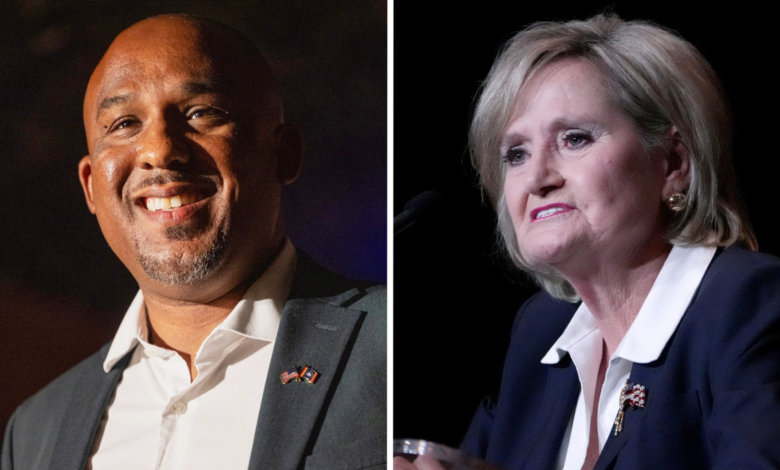
The race has become a historic anomaly for a state deeply aligned with the Republican Party. Mississippi voted for President Donald Trump with 61% of the vote in 2024 and elected Hyde-Smith to the Senate with 54% of the vote in 2020. Hyde-Smith originally took office by appointment in 2018. The current result represents a shock to local political expectations, as Mississippi has not elected a Democrat to the U.S. Senate since 1982. If Colom is certified as the winner, he would become Mississippi’s first Black U.S. senator since the Reconstruction era.
Colom, a district attorney for four counties along the Mississippi-Alabama border and a former nominee for a U.S. district judge, framed the campaign around accessibility and economic reality. In a press conference held prior to a recent rally, Colom addressed the contrast between his opponent’s campaign events and the financial constraints of his supporters, stating, “A lot of folks ain’t gonna be able to make this rally because they can’t afford the gas to get up here.” Hyde-Smith, speaking at a rally last month alongside President Trump, counter-attacked by characterizing Colom as “the most radical Senate candidate to run for Mississippi, literally, in our lifetimes.” President Trump’s presence at the rally was aimed at shoring up support for the incumbent in the final weeks of the campaign.

Independent challenger Ty Pinkins held 2.1% of the vote, with 19,934 votes as of Wednesday night. His presence in the race did not appear to split the vote significantly enough to determine the winner, as the margin between the top two candidates remains the primary focus of attention.
As the state moves toward the November 13 certification deadline, the political process will likely shift from the polling places to the courts. Without the ability to request a standard recount, any contest over the final tally will depend on the integrity of the ballot box exam and subsequent legal challenges. The outcome will not only determine which party controls the seat in the U.S. Senate but also test the administrative and legal frameworks Mississippi has in place for resolving close elections.