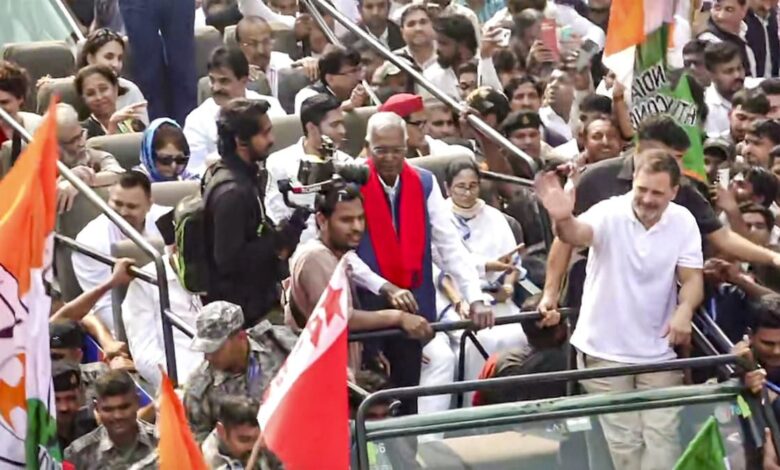
The dispute centers on the “Chalo Dilli” protest being held at Ramlila Maidan in New Delhi. The opposition alliance, led by the Indian National Congress (INC), organized the demonstration to campaign against alleged electoral irregularities and to demand the resignation of Chief Election Commissioner Gyanesh Kumar. However, the timing of the rally—coinciding with the anniversary of the 1984 anti-Sikh riots—has drawn intense criticism from the BJP leadership.
Nadda, who recently replaced home minister Amit Shah as party chief, argued that the opposition’s choice of date was calculated to “rub salt into the wounds of Sikh brothers.” He described November 1 as the “ugliest and darkest blot on India’s democratic history,” a day when, in his account, “goons patronised by Congress massacred our innocent Sikh brothers,” leaving thousands of families homeless. By linking the current protest to this historical tragedy, Nadda sought to frame the opposition’s actions not as a defense of democratic rights, but as an attempt to inflame communal tensions.
Beyond the historical grievances, Nadda highlighted the immediate economic and social consequences of the rally. He accused the opposition of adversely impacting the earnings of shopkeepers and traders in Delhi during the crucial festive season. “You cannot escape answering for the tears of Delhi’s traders,” Nadda stated, addressing Rahul Gandhi, the senior Congress leader. He further alleged that the protest was a strategy to “defame the country” and remove the democratically elected government through disorder rather than through the constitutional mandate.
The intensity of Nadda’s rhetoric reflects the BJP’s strategic shift in communication, moving from online barbs to street mobilization. As the party faces a “tough cycle” of state elections, Nadda’s role is pivotal. According to analyst Rahul Verma of the Centre for Policy Research, the BJP has struggled to maintain its hold on key states, having lost control of Rajasthan, Maharashtra, Jharkhand, and Chhattisgarh since late 2018. These losses have shrunk the party’s national footprint, even as Prime Minister Narendra Modi’s personal popularity remains largely undiminished.
Nadda’s ascent to the party presidency comes at a time of heightened polarization. The BJP’s recent policy moves, including the removal of special provisions for Kashmir, legal approvals for a temple at a contested site in Ayodhya, and the introduction of a new citizenship law, have hardened opposition against the party. While the government views these as fulfilling electoral promises, critics, including many Muslims and opposition parties, accuse Modi’s administration of pursuing a Hindu supremacist agenda. The recent wave of countrywide protests over the citizenship law has already caught the party on the wrong foot, adding to concerns about a flagging economy and rising inflation.
Internally, the BJP is working to unify its ranks and sharpen its electoral strategy. The Youth Congress, a key component of the opposition alliance, suspended 83 office-bearers across three states for missing the Ramlila Maidan rally, highlighting the organization’s internal discipline and mobilization efforts. In contrast, Nadda’s message to his own party members is one of resilience against what he perceives as an orchestrated attempt to destabilize the government.
Nadda, a veteran legislator who rose through the ranks of the student wing of the Rashtriya Swayamsevak Sangh (RSS) in the 1970s, has a long history with Modi, having worked alongside him in the early 1990s and serving as federal health minister during Modi’s first term. Now back in full-time party leadership, Nadda faces the challenge of balancing the outsized influence of Modi and Shah while crafting a strategy to reverse the BJP’s recent electoral setbacks.
The political standoff is set to continue as the opposition maintains its presence in Delhi. For the BJP, the next formal step involves leveraging this narrative to consolidate support in the upcoming state elections, particularly in Delhi, where the party is widely seen as trailing behind the incumbent local group. Nadda’s warning that the rally will be the “final nail in the coffin” of Congress’ political downfall signals a determination to frame the opposition’s actions as a futile and divisive stunt, rather than a legitimate political protest.