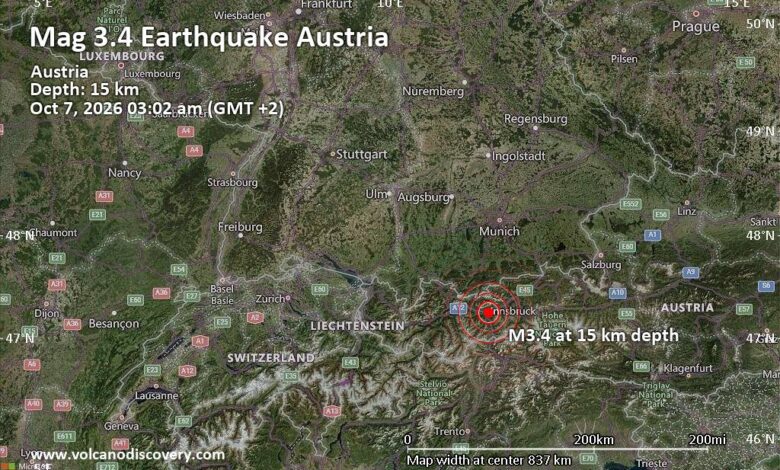
Tyrol is generally one of the most seismically active zones in Austria, and residents are accustomed to occasional tremors. However, the current pattern is notable not for the intensity of any single quake, but for the density of events occurring within a compressed timeframe. Of the 270 recorded events, 20 have been classified as “felt” by the public, indicating that the seismic waves were strong enough to be perceived by people in their homes or workplaces. The Seismological Service is currently monitoring this series continuously, analyzing the data to understand the underlying mechanisms driving this cluster.
The seismic energy release is not spread evenly across the broader region. Instead, the activity is concentrated in three specific geographical zones: east of Hall, southeast of Innsbruck, and north of the city center. This spatial clustering suggests that the stress is being released along specific fault lines or fracture zones rather than through a diffuse regional adjustment.
The most active of these three zones is located southeast of Innsbruck, specifically in the Sistrans–Patscherkofel area. This region has generated the vast majority of the earthquakes recorded since early September. It was here that the two strongest events of the current series occurred: a magnitude ML 3.8 earthquake on September 26 and a magnitude ML 3.7 earthquake on October 7. These events, while still within the moderate range, represent the peak of the current activity phase in terms of energy release. Numerous smaller earthquakes have also been recorded in this sector, contributing to the high total count.
A second zone of activity lies east of Hall. This area saw the onset of the current phase with the August 8 event. Following that initial shock, additional smaller events occurred throughout August and September, some of which were felt by the local population. The activity in this zone appears to have been a precursor to the more intense clustering observed later in the summer and early autumn.
The third active area is situated north of Innsbruck. While this zone has recorded several minor earthquakes in recent weeks, the magnitudes have generally been lower than in the southeast. The strongest event felt in this northern sector reached a magnitude of ML 2.1 on October 4. Despite the lower individual magnitudes, the cumulative effect of these tremors has contributed to the overall perception of increased seismic restlessness in the metropolitan area.
Scientists emphasize that the current activity does not necessarily indicate an imminent major earthquake. In tectonically active regions, such clusters can occur as the crust adjusts to stress, sometimes leading to a slightly larger event, but often resolving without significant escalation. The distinction between a temporary fluctuation and a precursor to a larger rupture remains a subject of ongoing analysis. The Seismological Service continues to track the frequency, magnitude, and location of these events to refine its understanding of the local seismic regime.
For the residents of Innsbruck and Hall, the impact has been primarily one of heightened awareness. The 20 felt earthquakes have served as tangible reminders of the geological forces at work beneath the Alpine foothills. While no structural damage has been reported in the available data, the clustering of events has prompted closer observation by both scientific institutions and the public. The coming weeks will likely provide further clarity on whether this activity phase is subsiding or if the fault systems in the Sistrans–Patscherkofel and Hall areas remain under significant stress.
The geological record of Tyrol shows that such periods of increased activity are part of the natural cycle of the region. However, the specific concentration of over 270 events in less than three months warrants sustained attention. As the monitoring continues, the focus remains on the three identified hotspots, where the interplay of tectonic pressure and local geology is currently being revealed in a series of measurable, if small, tremors.