
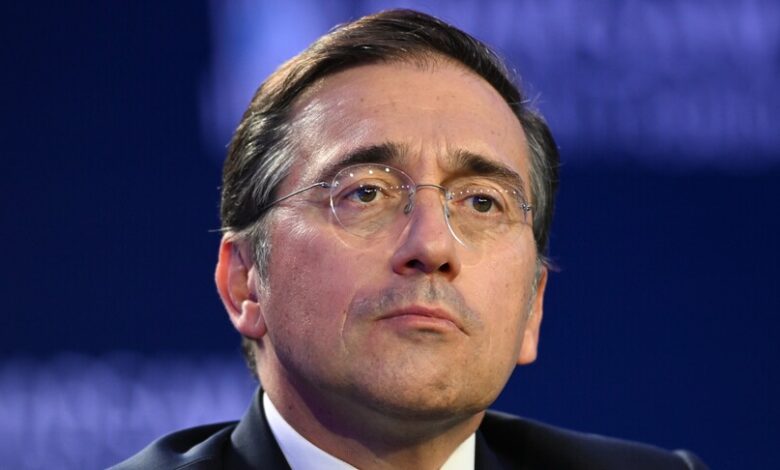
Madrid, Spain — Spanish Foreign Minister José Manuel Albares has officially framed a series of recent bomb threats targeting aircraft within Spain as part of a broader “hybrid attack” and “psychological warfare” campaign. In an interview with the Spanish state television network RTVE, Albares stated that while the precise origins of the threats require further investigation, the nature of the wave of incidents is not accidental. “For me, the most logical conclusion is that we are facing a hybrid attack and a psychological warfare attempt,” Albares said. This assessment elevates the incident from a potential criminal matter to a strategic security concern, positioning it within the context of ongoing efforts by external actors to weaken European cohesion.
The Foreign Minister’s comments come on the eve of significant domestic political activity, with early general elections scheduled for November 29. Albares explicitly linked the timing of these threats to the vulnerability of democratic institutions during election cycles. He warned that while he would not name specific actors, European nations must assume that such interference will occur, rather than merely hoping it might. “We must assume it will happen and take measures to prevent its impact, as we are doing across Europe, in Romania, Germany, France, and Eastern European countries,” Albares stated. This suggests a coordinated or at least parallel pattern of instability operations across multiple EU member states, targeting political confidence and social stability.
Operational Characteristics and Hybrid Threats
Albares drew direct parallels between the aviation threats and other recent hybrid incidents in Europe, such as cyberattacks on digital platforms and disruptions to critical infrastructure, specifically citing attacks on supermarket refrigerated warehouses. These examples illustrate the spectrum of hybrid warfare, which blends conventional security risks with economic sabotage, cyber intrusions, and psychological operations designed to erode public trust in government institutions and the rule of law. By grouping aircraft bomb threats with cyberattacks and supply chain disruptions, the Spanish government is signaling that it views these disparate events as components of a unified strategy to degrade Europe’s resilience.
The Minister acknowledged the forensic challenges associated with such operations, noting that identifying the specific perpetrators of these hybrid attacks would be difficult. This difficulty is inherent to the nature of psychological warfare, which often relies on ambiguity, attribution evasion, and the amplification of fear rather than direct kinetic engagement. The primary objective, according to Albares, is to exploit the European project’s core values—democracy, tolerance, economic growth, redistribution, and social justice—as vulnerabilities. He argued that actors wishing to return to a “law of the jungle” are disturbed by the European model and seek to destabilize it by creating an atmosphere of insecurity and division.
Strategic Implications for European Security
The strategic significance of this development lies in the potential for external actors to manipulate domestic political timelines. Albares noted that the European Commission is already taking election-period interventions into account, recognizing that sensitive times for societies offer opportunities for those seeking to dilute the European project. The warning is not limited to Spain; by citing Romania, Germany, France, and Eastern European countries, Albares implies a continent-wide awareness of these tactics. This suggests that European defense and security agencies may be coordinating information sharing regarding non-kinetic threats, treating political stability as a critical component of national defense infrastructure.

From a military and security perspective, the classification of bomb threats as “psychological warfare” shifts the burden of response from purely law enforcement to a broader national security framework. It implies that the threat is not necessarily about the physical detonation of a device, but about the disruption of civil aviation, the erosion of public confidence, and the politicization of security incidents. The Spanish government’s response must therefore balance rigorous investigation with resilience messaging, ensuring that the psychological impact does not translate into actual operational degradation of critical transport networks or political instability.
Future Outlook
As Spain approaches the November 29 elections, the focus will likely shift to whether any concrete evidence links the threats to specific foreign or domestic entities. While Albares has provided a strategic framework for understanding the incidents, the tactical details of who is behind the threats remain unverified. The coming weeks will test the effectiveness of European counter-hybrid measures, particularly in distinguishing between isolated criminal acts and coordinated state-sponsored or non-state interference. The resolution of this incident will serve as a case study for how European democracies respond to the intersection of physical security threats and political manipulation in the pre-electoral period.





One Comment