
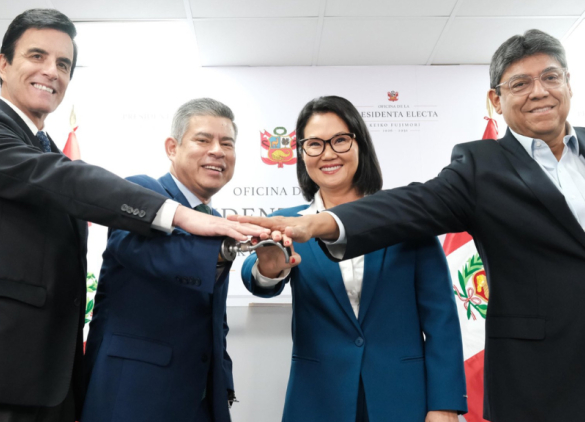
Fujimori exercised significant secrecy regarding her executive team, revealing ministerial appointments only on the eve of her inauguration. In a press conference held on July 27, she named her prime minister, economy minister, and foreign minister, adhering to the constitutional requirement that the prime ministerial designation precede other portfolios. The full cabinet of 19 ministers was sworn in on inauguration day. The composition of the government reflects Fujimori’s stated goal of prioritizing “experience and technical capacity,” with an openness to members outside her own Popular Force party. However, the cabinet remains predominantly male, with only two women among the 19 ministers, a proportion consistent with recent Peruvian administrations.
At the center of the new administration is Prime Minister Luis “Lucho” Galarreta, a 55-year-old former congressman and Fujimori’s first vice-president. Galarreta’s appointment places him first in the line of succession should Fujimori be removed from office. A politically active figure for over 35 years, Galarreta has a complex history within the fujimorista movement. Despite earlier criticisms of corruption within the political family, he joined the Popular Force party in 2016 and became a central figure in Fujimori’s inner circle. His political trajectory spans multiple right-wing parties, including the Freedom Movement, the National Renewal, and the Christian People’s Party.
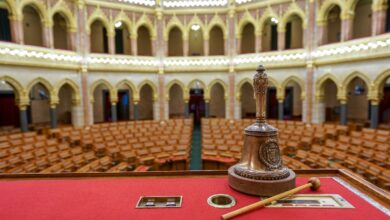
Galarreta’s tenure as president of Congress from 2017 to 2018 was a defining moment in recent Peruvian history. He became the first individual with a physical disability to lead the legislature, having both hands amputated at three months old and using prosthetics during his term. In that role, he oversaw the two impeachment votes that led to the resignation of President Pedro Pablo Kuczynski. He also presided over the suspension of three congressmembers, including Fujimori’s younger brother Kenji, for attempted vote-buying. Now, Galarreta is tasked with coordinating the cabinet and securing a vote of confidence from Congress within 30 days of taking office. He has outlined the government’s priorities as reducing insecurity, attracting investment, and creating jobs, framing these efforts as a “second-generation reform delayed for more than 20 years.”
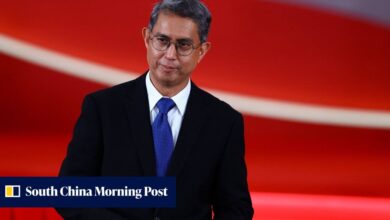
The economic pillar of the new government rests with Elmer Cuba, an economist who served as a Central Bank director from 2016 to 2021. Cuba, who advised Fujimori during her 2016 presidential campaign, brings extensive experience from global finance organizations rather than electoral politics. His mandate includes maintaining macroeconomic stability and ensuring that economic growth translates into better jobs, salaries, and public services for all Peruvians. Specific goals identified by Cuba include closing the infrastructure gap and cracking down on tax evasion.
Cuba faces an immediate and tangible challenge: preparing the national finances to withstand the impact of the El Niño climate phenomenon. Forecasts indicate that this season’s El Niño will produce severe flooding and increased heat, damaging infrastructure, fishing, and agricultural harvests. A major Peruvian investment company estimates that these events could generate losses equivalent to more than 1 percent of Peru’s GDP. This climatic threat underscores the urgency of the administration’s infrastructure and economic resilience plans.
The new administration inherits a political environment marked by deep polarization and institutional fragility. Fujimori’s victory, while decisive in the runoff, was narrow, leaving her with a mandate that requires careful navigation of congressional dynamics. The cabinet’s mixed composition, blending technocrats with loyalists, suggests a strategy to project competence while maintaining internal cohesion. However, the limited representation of women in the cabinet and the controversial history of some appointees within the fujimorista movement may fuel opposition critiques regarding inclusivity and institutional integrity.
As the 30-day clock ticks down to the vote of confidence, the focus shifts to how effectively the Galarreta-led cabinet can present a unified agenda to Congress. The success of the Fujimori administration will likely be measured not only by its ability to manage the immediate economic shocks of El Niño but also by its capacity to deliver on the promised reforms in security and investment, thereby stabilizing a nation that has struggled with governance continuity for nearly a decade.