According to the U.S. Energy Information Administration’s (EIA) September Short-Term Energy Outlook (STEO), underground storage inventories in the U.S. are on track to approach 4 trillion cubic feet (Tcf) by the end of October. This level represents the second-highest end-of-October inventory level on record. The abundance of supply is underpinned by continued growth in dry natural gas production, which the EIA forecasts will reach nearly 112 billion cubic feet (Bcf) per day in 2026.
This production growth is being facilitated by new infrastructure. Energy Transfer’s Hugh Brinson intrastate pipeline, which entered service in June, is expected to ramp up operations into early 2027. The pipeline moves natural gas from the Permian Basin near the Waha Hub to Maypearl, Texas, alleviating local bottlenecks and supporting broader market access. With such ample supply, domestic prices have remained subdued. Henry Hub prompt-month prices settled at $3.02 per million British thermal units (MMBtu) on September 23, a level maintained through the contract expiration and transition to the November prompt-month contract.

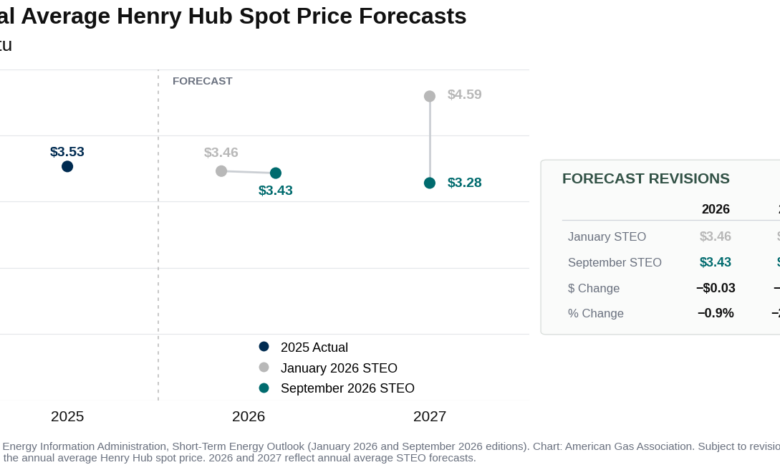
The EIA reports that inflation-adjusted Henry Hub spot prices averaged $2.93 per MMBtu from June through August 2026, a 6 percent decline compared to the previous summer. Looking ahead, the agency revised its average spot price outlook slightly lower in the September STEO, projecting $3.43 per MMBtu for 2026 and $3.28 per MMBtu for 2027. Notably, the 2027 forecast is nearly 29 percent below the $4.59 per MMBtu average projected in the January STEO, reflecting a significant downward revision in expected market tightness over the longer term.
In contrast, the European market presents a more volatile and constrained outlook. Timera Energy reports that European and Dutch natural gas storage inventories were approximately 67 percent and 50 percent full, respectively, in mid-September. These figures indicate that reserves are significantly below historical norms for this time of year, leaving the region vulnerable to demand spikes or supply interruptions. Analysts note that Europe is set for another year of high gas prices, a dynamic that remains distinct from the U.S. market despite global interconnections.

Geopolitical developments are a primary source of uncertainty for global energy markets. Rystad Energy reports that Brent crude oil prices moved above $100 per barrel in mid-September as concerns over regional supply disruptions in the Middle East intensified. While U.S. natural gas markets remain relatively insulated from these specific supply shocks, the broader rise in global energy prices has contributed to inflationary pressures. Rystad Energy notes that these factors were a key driver behind the Federal Open Market Committee’s decision on September 16 to raise its benchmark interest rate by 25 basis points to a range of 3.75–4 percent.
The interplay between energy prices and monetary policy highlights the systemic consequences of market developments. Higher borrowing costs resulting from the rate hike could weigh on economic activity and, consequently, energy demand. However, for the immediate term, the U.S. market’s trajectory is defined by its physical surplus. The combination of high inventories, new pipeline capacity, and strong production ensures that domestic pricing power remains limited, with spot prices hovering near the $3.00 per MMBtu threshold. Meanwhile, European buyers must navigate a tighter supply environment where storage deficits and geopolitical risks continue to support elevated price levels.