
The revocation of status follows a surge in cases that experts describe as unprecedented in recent history. Upwards of 5,400 cases have been recorded this year, more than double last year’s count and the highest number since 1991. In total, more than 7,500 cases have been reported in the past two years. Noel Brewer, a public health professor at the University of North Carolina at Chapel Hill, noted that the U.S. has experienced more measles cases in the last 18 months than in the previous 25 years combined. The severity of the outbreak is underscored by mortality data: ten people have died this year, according to state health departments, with at least four of those deaths occurring in babies too young to be vaccinated.
Compounding the outbreak is the emergence of congenital measles, a condition that doctors describe as a “brand new phenomenon.” Preliminary figures published in a medical journal indicate that 13 cases of congenital measles were reported from the start of 2025 through September, during which time 112 cases of confirmed measles occurred during pregnancy. Michael Osterholm, who directs the University of Minnesota’s Center for Infectious Disease Research and Policy, explained that this situation is driven by a specific demographic shift. “What’s happening is we have so many women of childbearing age who were not vaccinated in the last 25 years, nor have they ever had exposure to measles because for the last 25 years we have beaten it back,” Osterholm said. “Now, this group is highly susceptible to measles.” Because the virus can be passed from mother to fetus in the womb, these infections can lead to serious complications, including pneumonia, encephalitis, and a rare, often fatal brain disorder known as SSPE.
The root cause of this resurgence is a sharp decline in vaccination coverage, which has fallen below the threshold necessary to prevent community spread. The threshold for herd immunity against measles is generally accepted as 95%. As of the 2025-2026 school year, only 92% of kindergarteners had been vaccinated for measles, down from 95% in the 2019-20 school year. An NBC News investigation found that 75% of counties and jurisdictions with data fall below this critical rate. Since 2019, 82% of counties and jurisdictions have reported declines in vaccination rates. In some rural areas, such as Catron County in New Mexico and Adams and Custer counties in Idaho, vaccination rates for kindergarteners have dropped below 50%.
The PAHO commission, which deliberated for four days in Washington, D.C., evaluated genetic data from “homegrown” cases to determine if outbreaks across states were linked. They also weighed vaccination coverage, surveillance quality, and the U.S. strategy and resources for responding to outbreaks. Walter Orenstein, former director of the U.S. Immunization Program at the Centers for Disease Control and Prevention, highlighted the immediate risk to unvaccinated individuals. “People can go into a supermarket and get infected,” Orenstein said. Measles is among the most contagious viruses known to humans, with one infected person capable of spreading the virus to 9 out of 10 others in close proximity. The virus can linger in the air for up to two hours, posing a significant threat to infants who are not eligible for their first vaccine dose until they turn one, as well as those who are immunocompromised.
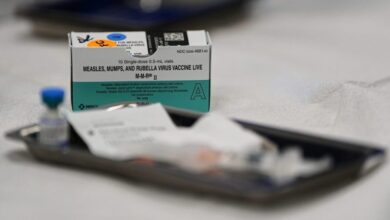
Public health officials and experts are responding with a mix of clinical guidance and urgent appeals for vaccination. Some health departments in outbreak zones are now recommending an early dose of the MMR vaccine for infants as young as six months. For women of childbearing age, the best prevention strategy is to get the MMR vaccine before pregnancy, as antibodies pass from mother to baby through the placenta, providing protection for a few months after birth. Unvaccinated women who are exposed while pregnant can receive a solution containing antibodies within six days to reduce the risk of infection and complications. However, MMR cannot be given during pregnancy.
The response from federal agencies has been a point of contention. A spokesperson for the Health and Human Services Department stated that the CDC has “mounted an aggressive response,” including allocating $100 million in additional funding in October and deploying experts to support state responses. CDC Director Dr. Erica Schwartz emphasized that losing the designation “doesn’t mean we abandon an evidence-based approach.” However, critics point to a lack of proactive media briefings and vaccination campaigns by the CDC compared to past administrations. Noel Brewer described the lack of action as “clear negligence,” noting that frequent public comments questioning vaccine safety have shaken parental confidence. Since taking office, Health Secretary Robert F. Kennedy Jr. has questioned the safety and effectiveness of measles vaccines, while President Donald Trump falsely suggested in August that the combined shot could be “quite lethal,” despite decades of evidence demonstrating its safety.
The loss of elimination status is not unique to the U.S.; Canada’s status was revoked last year following an outbreak that led to more than 5,000 cases. Jon Andrus, a global health professor at George Washington University and chair of the PAHO commission, noted that Canada’s loss was not due to a lack of effort, but rather the sheer force of the outbreak. “It wasn’t for a lack of effort in Canada,” Andrus said. “There was a political commitment at the highest level to sustain measles elimination and to stop that outbreak.”
Reclaiming the elimination designation could take years, requiring a sustained effort to raise vaccination rates back above the 95% threshold. Dr. Adam Ratner, a member of the American Academy of Pediatrics’ infectious diseases committee, stressed the necessity of this work. “We need to get back to the point where everybody who can get vaccinated is getting vaccinated, and that’s gonna take some doing,” Ratner said. As the U.S. navigates this new endemic reality, the focus remains on protecting the most vulnerable: infants too young for vaccination and pregnant women facing a virus that has, for the first time in decades, returned to the point of causing congenital infections.