
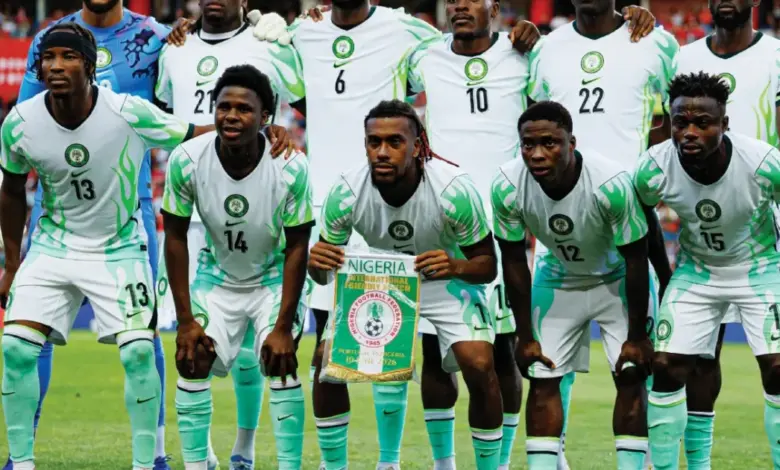
A Collapse in Bissau
The match in Bissau was defined by Nigeria’s inability to impose their will on the game. Guinea-Bissau dominated the contest from start to finish, leaving the Super Eagles with minimal possession and little chance to organize their attack. The visitors’ control was punctuated by three decisive goals that sealed Nigeria’s fate.
Franculino broke the deadlock in the 15th minute, giving Guinea-Bissau an early lead that Nigeria never recovered. The pressure continued to mount in the second half, with Balde extending the advantage in the 66th minute. The final blow came in the dying moments of the contest, as Djalo scored in the 95th minute (90+5) to make it 3-0, a result that underscores the tactical and mental fragility currently plaguing the Nigerian side.
Qualification on the Brink
The competitive stakes of this group are uniquely high due to the structure of the 2027 AFCON qualifiers. Group L consists of only four teams, and because co-hosts Tanzania are exempt from the qualifying process, only one team will qualify from the group. Tanzania’s results do not count toward the final standings, meaning the competition is effectively a three-way battle for a single spot.

Guinea-Bissau have seized the initiative with two wins from two matches, defeating both Tanzania and Nigeria. Nigeria, managed by Eric Chelle, began their campaign with a 2-1 victory over Madagascar at the Godswill Akpabio Stadium in Uyo on September 25. However, the subsequent collapse in Bissau has made Nigeria’s path to the final tournament far from guaranteed. Even a home victory against Guinea-Bissau in the return fixture can no longer be taken for granted, as the Eagles must now navigate a precarious position in a group where consistency is paramount.
A Pattern of Decline
This defeat is not an isolated incident but the latest in a series of setbacks that have eroded Nigeria’s status as a continental powerhouse. The Super Eagles, who have won the AFCON title three times (1980, 1994, and 2013) and reached the semifinals in the last two editions, have struggled to maintain their competitive edge in recent years.
The decline was evident in the 2026 World Cup qualification cycle, where Nigeria failed to secure a spot despite the expansion of the tournament to 48 teams. The team was eliminated by the Democratic Republic of Congo in the playoff rounds, a result that highlighted a lack of urgency and tactical coherence. Administrators and players have faced repeated criticism for unpaid bonuses and institutional mismanagement, with political interference in football appointments often cited as a root cause of the dysfunction.

The rot is not confined to the pitch. The players appear to have lost some of the hunger and urgency that once defined the Eagles. Administrators are distracted by politics and power struggles, while governments keep meddling in football appointments, often rewarding loyalty over competence.
Nigeria’s recent history is marked by missed opportunities. The country missed the 2006 World Cup after a long streak of appearances, and has also failed to qualify for the 2012, 2015, and 2017 AFCON tournaments. The current trajectory suggests a risk of further absence from the continent’s premier competition.
The 3-0 loss to Guinea-Bissau serves as a stark warning. For a nation with a rich footballing pedigree, the failure to learn from previous defeats has allowed the decline to become institutionalized. As the qualifiers progress, the Super Eagles face an uphill battle to reverse a trend that has seen them fall down the continental pecking order. The next phase of the tournament will require not just tactical adjustments, but a fundamental recalibration of the team’s approach and management structure to avoid watching the 2027 AFCON from the sidelines.