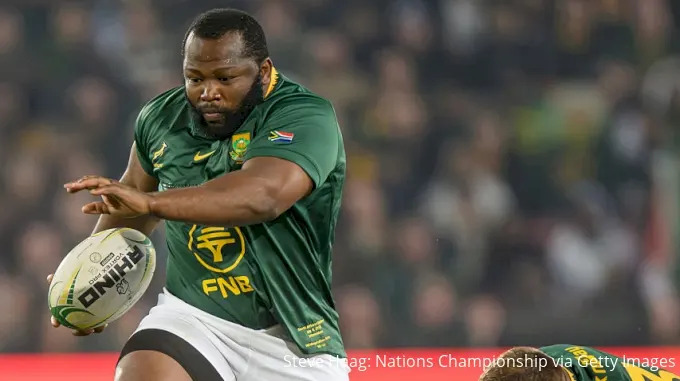
The contest was defined by a stark contrast in preparation and personnel. Italy entered the match significantly weakened, decimated by injuries that compromised their depth. In response, head coach Rassie Erasmus fielded a near-full-strength side, aiming for a physical and technical dismantling of the Azzurri. The strategy proved effective from the opening whistle, with South Africa’s forwards establishing such a heavy hand that the backs were barely required to join the attack in the opening 40 minutes.
The first half was a one-way traffic affair. South Africa overwhelmed Italy’s defense, crossing the whitewash line six times to build a staggering 45-0 lead at halftime. Malcolm Marx was prominent, scoring twice, while fly-half Sacha Feinberg-Mngomezulu orchestrated the offensive flow, contributing a try, several conversions, and a penalty goal. The relentless scoring pace raised real questions about whether a 100-point performance was achievable, a feat rarely seen in this tier of international rugby.
By the time the second half commenced, the momentum had shifted. With the result already secured, the Springboks eased off the pedal, showing less urgency and making errors that allowed Italy to find pockets of rhythm. This tactical relaxation, combined with Italy’s improved defensive structure, made the latter stages of the game more competitive. Federico Ruzza finally broke through for the Azzurri’s lone try, with Tommaso Allan adding the conversion to offer some dignity to the Italian cause.
Despite the slowdown, South Africa maintained attacking intent in key moments, finishing the match with nine tries. Contributions from Wilco Louw, Paul de Villiers, and Ethan Hooker ensured the Springboks added significantly to their lead in the second half. Hooker, in particular, shifted into the midfield in the second half, where he saw more of the ball and provided a vital link between the forwards and the backline. His aerial dominance throughout the match made it a bonus for Italy if they managed to gain possession from South African box kicks.
Individual performances highlighted the depth of the Springbok squad. Ethan Hooker rated highly for his all-around contribution, while Damian Willemse, though having a quieter start, was astute in supporting Jasper Wiese’s break for a try and later involved in creating scoring opportunities. Jesse Kriel provided a standout moment of skill, winning a penalty over the ball and making a surging run that set up Wilco Louw’s try. The forward pack, led by Siya Kolisi, Pieter-Steph du Toit, and Damian Willemse, controlled the collision and territory, forcing Italy to play from their own half for the majority of the contest.
The result reinforces South Africa’s status as a formidable force in the 2026 Nations Championship. With 15 points from four matches, they remain at the top of their standings group. The performance also serves as a significant statement ahead of future international fixtures, demonstrating that even against a compromised opponent, the Springboks can impose their will through structural superiority and physical dominance. For Italy, the match highlights the challenges of injury management, but their ability to find a try and compete in the second half offers a baseline for rebuilding.
As the tournament progresses, South Africa’s next fixture will test their consistency against a potentially more intact opposition. The 66-7 scoreline may be the headline, but the tactical execution in the first half—a 45-0 margin that required no defensive concessions—remains the most significant takeaway from the Turin encounter.