
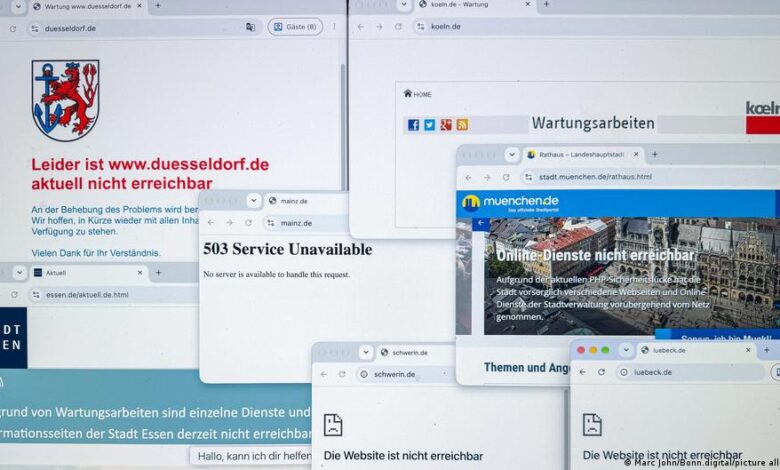
While many sites have restored service, disruptions persisted into Thursday for some state government portals, hospitals, and universities. The BSI issued a stark warning that the threat environment remains volatile. “We consider it likely that there will be widespread exploitation within a few hours of the security updates being released,” the office stated. The primary concern is the ability of attackers to utilize AI-powered tools to analyze the security updates rapidly and generate corresponding exploits. Consequently, the BSI recommended that organizations completely disconnect vulnerable websites from the internet until security can be guaranteed.
The incident highlights the growing complexity of maintaining security in a digital landscape where legacy systems coexist with modern threats. Experts caution that fully securing all government, public, and private devices will be a protracted process, potentially taking months. This timeline is driven by the prevalence of outdated software that cannot be remediated through simple patching. Furthermore, determining the extent of any potential hacks that may have occurred prior to the takedown remains an ongoing investigation, with online security officials noting that ascertaining the scale of any compromise will require significant forensic analysis.
The use of PHP, which powers a substantial portion of the web, underscores the systemic risk posed by critical vulnerabilities in widely adopted technologies. The speed with which the vulnerability was exploited—or anticipated to be exploited—by AI-assisted tools marks a shift in cybersecurity dynamics. Attackers no longer need to spend weeks reverse-engineering patches; instead, they can leverage machine learning to identify weaknesses in real-time. For public institutions, this necessitates a move from reactive patching to proactive isolation strategies when security cannot be immediately assured.
Separate from the cybersecurity crisis, the German government released a report detailing a significant rise in far-right martial arts clubs. The number of such groups has increased from approximately a dozen in June 2024 to 20 active clubs as of now. The Interior Ministry noted a major increase in 2026, characterizing a “professionalization of combat skills” among these groups. While the report found no evidence of direct confrontations with opposing groups or international links at this stage, it warned of potential threats of violence. The report was commissioned following a parliamentary inquiry by the Greens party, highlighting the increasing intersection of extremist recruitment and physical training facilities.
In energy infrastructure news, Germany has seen a rapid expansion in battery storage capacity. According to the solar industry association BSW-Solar, the number of battery systems increased by nearly half a million between January and September 2026, representing a 91% increase over the same period last year. These new installations have a combined storage capacity of 8.2 gigawatt-hours, equivalent to the electricity consumption of Munich in just under half a day. The growth is driven largely by large-scale systems, with the number of installations at 1 megawatt or more rising from 63 to 220. Carsten Körnig, managing director of BSW-Solar, described battery storage as a “driver of growth and efficiency” in the energy transition, noting that the technology could save billions in costs. However, the association emphasized that the current pace of expansion is insufficient to meet Germany’s long-term clean energy goals.
Elsewhere in Germany, police are investigating a possible arson attack in Leipzig, where more than 20 MAN trucks were set on fire in the Sellerhausen-Stünz neighborhood early Thursday. The fire, which broke out around 2 a.m., resulted in several vehicles being completely destroyed, with initial damage estimates reaching seven figures. The Police Center for Countering Extremism and Terrorism has taken over the investigation, as a political motive cannot be ruled out. Fire services contained the flames by morning, and no injuries were reported.
As the cybersecurity situation stabilizes, attention will turn to the forensic analysis of affected systems. The confirmed next step in the regulatory and technical process involves the continuous monitoring of network traffic for signs of exploitation following the deployment of the PHP patch, ensuring that no residual vulnerabilities remain in the public sector’s digital infrastructure.