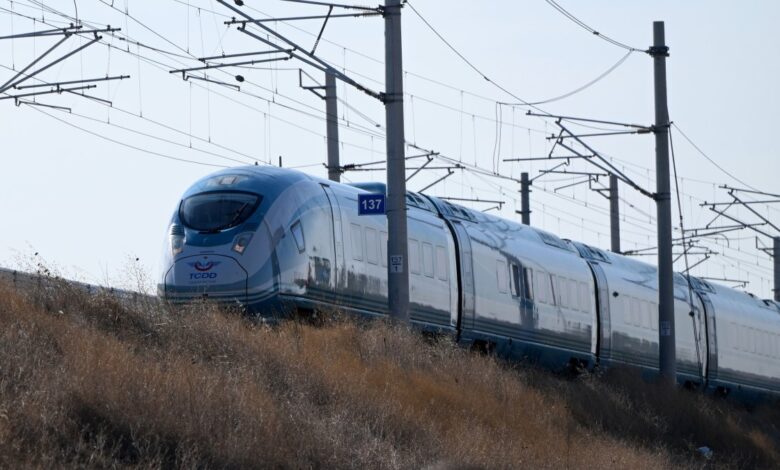
This new segment represents the longest portion of the 229-kilometer Halkalı-Kapıkule line, which originates at Halkalı on Istanbul’s western edge. The technological specifications of the line are designed to maximize throughput and speed. The track is double-track, electrified, and signalized, with a design speed of 200 kilometers per hour. For passengers, the impact is a reduction in travel time between Halkalı and Kapıkule from four hours to one and a half hours. For freight operators, the implications are equally stark: transit times are projected to drop from 8.5 hours to 3.5 hours. Officials estimate that annual passenger capacity will surge from 600,000 to approximately 3 million, while freight capacity is expected to rise from 1.5 million to 9.5 million tons. This expansion brings the number of Turkish provinces served by high-speed rail to 14, integrating key industrial and economic hubs into a faster, more efficient logistics corridor.
While the infrastructure expansion connects Türkiye to Europe, a parallel development within the country’s industrial sector is reshaping the supply chain for these very lines. For decades, high-speed rail technology was dominated by a few international manufacturers. That dynamic is shifting as Türkiye Raylı Sistem Araçları AŞ (TÜRASAŞ), a state-owned rolling stock manufacturer, advances its first domestically designed and built high-speed train. Minister of Transport and Infrastructure Abdulkadir Uraloğlu announced that the train has reached 240 km/h during ongoing testing, a milestone that follows earlier trials where the vehicle achieved 225 km/h during dynamic braking tests.
The technical architecture of this domestic train reflects a strategic effort to localize critical components. The vehicle consists of eight aluminum-bodied cars with a capacity for 577 passengers. Crucially, two of the train’s most complex systems—the train control and management system and the traction system—were designed and manufactured locally in cooperation with ASELSAN, a firm specializing in electronic systems for defense and critical infrastructure. This collaboration aims to reduce dependence on foreign suppliers and build an autonomous industrial base. The train is equipped with modern amenities and safety features, including an automatic train stop system, electromechanical passenger doors, fully automatic air conditioning, and a fire detection system. Accessibility has also been prioritized, with two dedicated compartments for passengers with reduced mobility and elevators facilitating boarding for wheelchair users.
This domestic production effort is part of a broader national strategy that has earmarked over $6 billion for 91 railway projects by 2032. The government’s vision is to transform the railway sector into a primary engine of economic growth and a strategic hub connecting Europe, the Caucasus, the Middle East, and Central Asia. The 2026 public investment program prioritizes the completion of major high-speed lines, including Ankara–Izmir, Sivas–Erzincan, and the Konya–Karaman–Mersin–Adana axis. The goal is to shift a significant share of passenger and freight traffic from road to rail, thereby cutting travel times and enhancing economic competitiveness.
However, the transition from test track to full commercial service requires rigorous verification. Uraloğlu noted that while the 240 km/h milestone is significant, the testing process continues to examine speed, braking capability, running performance, dynamic behavior, and compatibility with existing railway infrastructure. The program will not be considered complete until the trains reach their maximum design speed and fully meet all safety and comfort criteria. Until these final verifications are complete, the domestic fleet remains in the trial phase, a necessary step before it can join the expanding network that now reaches the EU border.
As the new Kapıkule line begins to carry its first passengers and freight, it serves as a physical manifestation of Türkiye’s dual strategy: expanding the hardware of its transport network while simultaneously mastering the software and mechanics of its rolling stock. The reduction in transit times to the EU border offers immediate logistical benefits, but the long-term significance lies in the domestic capability to manufacture the trains that will run on them. The next confirmed step is the conclusion of the current testing phase for the TÜRASAŞ train, which will determine when this locally built technology can enter regular service on the newly electrified corridors.