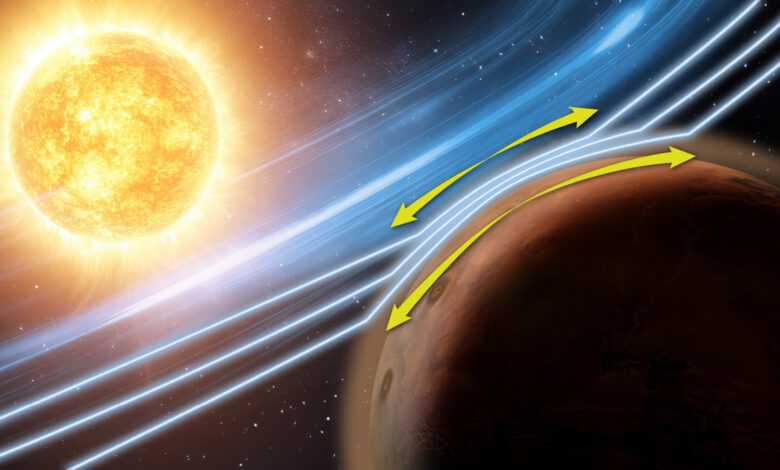
The detection occurred during a large solar storm event in December 2023. Christopher Fowler, a research assistant professor at West Virginia University and lead author of the study, noted that the magnetic field measurements exhibited distinct fluctuations, or “wiggles,” that did not fit standard models. After ruling out other possibilities, the team determined that the solar storm amplified the Zwan-Wolf effect to detectable levels. Fowler stated that the effect may be occurring constantly in the Martian ionosphere but at levels too low for MAVEN’s instruments to register under normal conditions. This finding provides new insight into how space weather alters the Martian environment, with potential implications for understanding similar unmagnetized bodies such as Venus and Saturn’s moon Titan.
In parallel, data from the Perseverance rover has confirmed the presence of macromolecular carbon in mudstones within Jezero Crater, representing the highest concentration of organic molecules found on Mars to date. Published in *Science Advances*, the study utilized the rover’s SHERLOC instrument to map carbon distribution in the Bright Angel outcropping. The researchers found that the carbon was not heavily weathered, suggesting it may have been exposed relatively recently in geological terms. Ashley Murphy, a co-author of the study, emphasized that while the location near other potential biosignatures is significant, the presence of macromolecular carbon alone does not prove the existence of life. The molecules could have formed through nonbiological processes, such as meteor impacts or chemical reactions involving running water.
Earlier findings from the Curiosity rover in Gale Crater further contextualize the prevalence of organic material on Mars. A separate study in *Nature Communications* reported the detection of 20 organic molecules, including benzothiophene, in clay-rich regions. Amy Williams, a professor at the University of Florida and lead author, explained that these molecules were released from complex aromatic materials using a chemical etchant. While benzothiophene is known to form in the interstellar medium and on meteorites, its presence on Mars could indicate that organic building blocks were delivered by space debris. However, the study did not determine whether these compounds were produced by native biology or arrived extraterrestrially.
Geological observations by Curiosity have also revealed a previously unseen landscape in Valle Grande. Images captured in June 2026 show a vast field of polygonal fractures, or “honeycomb” patterns, measuring 4 to 8 centimeters across. These formations stretch across the valley floor and wrap around a 6-meter-tall butte named Miraflores. Ashwin Vasavada, the mission’s project scientist, described the scale of the formation as taking the team’s breath away. While similar small clusters have been seen before, the extent of this field is unprecedented. Scientists are currently analyzing the shapes and chemistry of these fractures to determine their origin, with hypotheses including thermal fracturing from temperature changes or compression that forced water out of sediment layers.

Together, these findings from the MAVEN, Curiosity, and Perseverance missions expand the understanding of Mars’ atmospheric physics, chemical inventory, and surface geology. The Zwan-Wolf effect highlights the dynamic interaction between the Sun and the Martian ionosphere, while the detections of complex carbon and organic molecules underscore the need for further investigation into the planet’s potential habitability. The geological honeycomb formations provide a new target for studying past water activity. As the MAVEN mission continues to face operational challenges, including a loss of signal in late 2025, the data already collected remains a critical resource for planetary science.