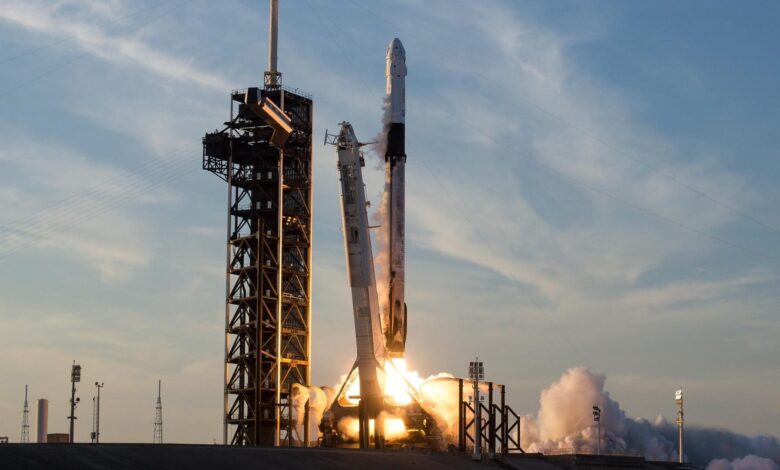
The second launch of the day was the Transporter-18 rideshare mission, which lifted off from Vandenberg Space Force Base in California at 2:18 p.m. EDT (18:18 GMT). This Falcon 9 rocket carried 130 payloads to orbit, including a prototype satellite for Google’s Project Suncatcher AI constellation. The day concluded with the launch of a Falcon Heavy rocket from NASA’s Kennedy Space Center at 11:53 p.m. EDT (03:53 GMT on October 2). This vehicle carried the classified NROL-97 mission for the U.S. National Reconnaissance Office. SpaceX achieved a similar three-launch timeframe only once previously, in March 2025, when three Falcon 9 rockets launched within a 12.5-hour window.
Following this intensive launch period, SpaceX conducted another significant deployment on October 11. A Falcon 9 rocket launched at 12:39 a.m. PDT (03:39 EDT / 07:39 UTC) from Vandenberg Space Force Base, carrying 21 data satellites for the U.S. Space Development Agency (SDA). This mission, designated Tranche 1 Transport Layer A (T1TL-A), was the fourth flight sending production satellites for the SDA’s Proliferated Warfighter Space Architecture (PWSA) constellation.
The October 11 launch was the second attempt for this specific mission. The initial try on October 5 was scrubbed by an auto-abort with 58 seconds remaining on the countdown clock. The hold was triggered by “some off-nominal data on Stage Two,” according to SpaceX. The vehicle was lowered to a horizontal position for troubleshooting, and the launch was delayed day by day to allow for system checks and range deconfliction, which included resolving a missile test conflict at Vandenberg that occurred on Friday, October 10.
During the successful October 11 flight, the Falcon 9 first stage booster, identified as B1103, executed its sixth flight. Approximately 7.5 minutes after liftoff, the booster landed at Landing Zone 4. This marked the 37th landing at that specific site and the 668th Falcon booster landing to date. The 21 satellites, manufactured by Northrop Grumman, were delivered to Vandenberg on September 28.
The T1TL-A mission contributes to the broader PWSA constellation, designed to support U.S. military and allied capabilities through space-based assets such as missile tracking and secure communications. Tranche 1 of the PWSA is expected to begin providing operational capabilities to the Department of Defense in 2027. When fully complete, Tranche 1 will consist of 126 Transport Layer satellites, 28 Tracking Layer satellites, and four missile defense demonstration spacecraft. As of the October 11 launch, 63 satellites from the Tranche 1 missions are in orbit, having been deployed across the T1TL-A, T1TL-B, T1TL-C, and T1TL-E missions. These launches fall under the National Security Space Launch (NSSL) Phase 2 contract awarded to SpaceX in August 2020.