The trajectory of the disease in the United States has shifted dramatically since early 2025, when an outbreak in Texas sparked the country’s largest bout of measles in three decades and fueled a deadly outbreak in northern Mexico. Since then, the virus has found fertile ground in communities where vaccination rates have fallen below the critical threshold. In Pennsylvania, the spread accelerated from a dozen cases in the first quarter of 2026 to 106 new cases in the week leading up to early October. The demographic profile of the infected has also changed; while early cases were predominantly young children, two-thirds of current cases are in adults. Fewer than 1% of those infected have received the measles, mumps, and rubella (MMR) vaccine, highlighting the failure of herd immunity in these specific communities.
Public health officials attribute this resurgence to a combination of rising vaccine hesitancy and significant policy disruptions. Data from the Centers for Disease Control and Prevention (CDC) indicates that U.S. vaccine exemptions, driven by personal or religious reasons, reached an all-time high, increasing by 18% between the 2024-25 and 2025-26 school years. This trend coincides with a period of instability in federal vaccine policy. Under the leadership of Health and Human Services (HHS) Secretary Robert F. Kennedy Jr., attempts to revise the pediatric vaccine schedule resulted in a reduction of covered diseases from 17 to 11. In March 2026, a federal judge stayed these decisions, ruling that Kennedy’s appointed members of the Advisory Committee on Immunization Practices (ACIP) were unqualified to alter vaccine policy. Despite this legal stay, the administration continued to push for changes, with President Donald Trump issuing an executive order on August 10, 2026, recommending the splitting of the MMR vaccine into three separate shots and the further reduction of the childhood schedule. As of late April 2026, the ACIP had not reconvened, leaving a regulatory vacuum that has complicated public health responses.
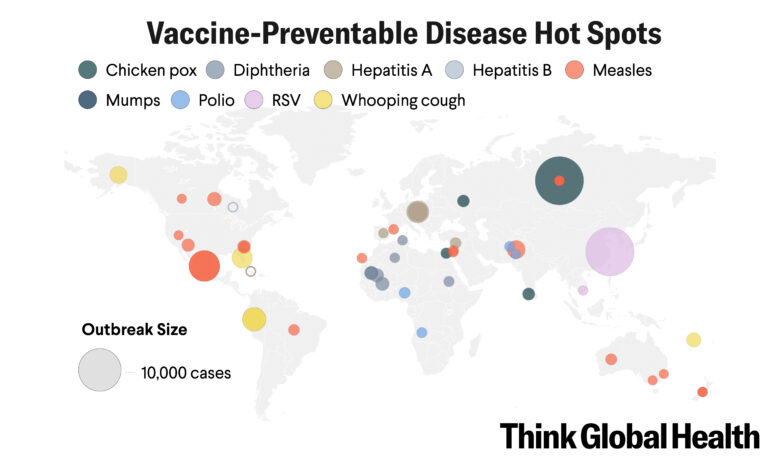
The impact of these policy shifts and declining vaccination rates is not confined to the United States. Globally, the World Health Organization (WHO) reports that the Southeast Asian region now leads the globe in confirmed measles cases, driven by a severe outbreak in Bangladesh that has resulted in more than 1,000 deaths between March and October 2026. In Europe, six countries, including the United Kingdom, lost their measles elimination status in January 2026 after continuous transmission persisted for more than a year. England alone has recorded 407 cases in 2026. Similarly, Canada lost its elimination status in November 2025 after three decades of maintenance, a lapse driven largely by low vaccination rates in certain communities. Consequently, the Pan American Health Organization (PAHO) region lost its overall elimination status for the third time in seven years, with the U.S. and Mexico’s status set for review in November 2026.

Medical experts emphasize that the current outbreaks are not merely a return of a childhood rash but a public health emergency with lethal potential. Dr. Stinchfield notes that measles is not a benign illness; infants, pregnant women, and immunocompromised individuals face the highest risks of severe complications and death. The concept of “cocooning”—vaccinating the immediate circle of family and friends to protect those who cannot be vaccinated—has become increasingly difficult to implement as community-wide immunity erodes. In Pennsylvania, while state and local health departments have successfully deployed pop-up vaccination clinics and home visits, the virus continues to spread in counties where MMR vaccination rates have dropped below the 95% threshold required for community immunity. Conversely, counties with no reported cases are those that have maintained vaccination rates above this benchmark, illustrating the direct correlation between immunization coverage and disease containment.
The MMR vaccine, administered in two doses at least 28 days apart, remains 97% effective and is the only proven method to prevent measles without the dangers of natural infection. However, its efficacy relies on high population coverage. As the virus spreads, it targets the unvaccinated, creating a “spiderweb” of transmission where each infected person can infect 12 to 18 others. The resurgence of whooping cough (pertussis) in 2026, with fresh outbreaks in Argentina, Brazil, Canada, Honduras, and parts of the U.S., suggests a broader pattern of vulnerability to vaccine-preventable diseases. In Vanuatu, for instance, a pertussis outbreak beginning in 2025 has already claimed seven lives, while Guam reported its first cases since 2015.
As the U.S. prepares for the November 2026 review by PAHO, the focus remains on reversing the trend. The next verified development hinges on the ability of public health authorities to restore trust, clarify vaccine schedules, and achieve the 95% vaccination threshold in vulnerable communities. Until then, the risk remains acute for the unvaccinated, as the virus continues to find gaps in the shield of community immunity.